


What is the story about?
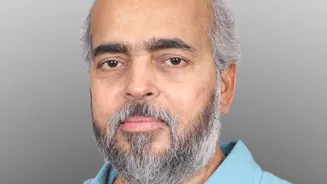
For most of history, a heatwave was simply bad luck, an act of nature or of the gods that no one could be blamed for. Krishna AchutaRao belonged to the small
group of scientists who changed that. He could look at a brutal Indian summer and calculate, in hard numbers, how much of its ferocity was the work of human hands. That quiet, difficult skill made him one of India's most important climate voices, which is why the news of his death, on 4 September 2026 at the age of sixty-two, landed so heavily on the country's scientific community. Also Read: Who Is Mahant Swami Maharaj, The Spiritual Leader Of BAPS Amid The Eiffel Tower Controversy
The Science Of Assigning Blame
AchutaRao worked in a field called attribution science, one of the most consequential ideas in modern climate research. When a devastating heatwave or flood strikes, attribution scientists run the real-world event against simulations of a world without human-caused warming, and measure the difference. The gap between the two is the fingerprint of humanity. It is painstaking work, built on climate models and statistics, and it transforms a vague sense that the weather is worsening into a precise, defensible statement that a particular disaster was made so many times more likely, or so many degrees hotter, by the way we live. AchutaRao was among the Indians who brought that rigour to bear on the subcontinent's own extreme summers.
A Career At The Frontier
A professor at the Centre for Atmospheric Sciences at IIT Delhi, where he taught for around two decades, AchutaRao helped establish the extent to which human-induced warming could be detected in India's own temperature records, linking the abstractions of global climate science to the very real risks faced on Indian soil. His standing reached well beyond Delhi. He contributed to the Intergovernmental Panel on Climate Change, the UN body whose assessments shape global policy, worked with the international World Weather Attribution network, and sat on the scientific committee of the World Climate Research Programme. At IIT Delhi, he was instrumental in setting up its Centre of Excellence for Climate Change Adaptation.
The Communicator and The Conscience
What colleagues remembered, alongside the rigour, was the man. He was known as an unusually clear communicator, able to translate forbidding climate concepts into language ordinary people could grasp, and as a principled voice who cared deeply about protecting the poorest and most vulnerable from a warming world. In recent years he had begun studying how artificial intelligence might sharpen climate and monsoon research, still pushing at the frontier even late in his career. Fellow scientists paid tribute to his scientific temper, his meticulousness and his sense of humour.
What He Leaves Behind
His death, after a period of ill health, robs India of a scientist at exactly the moment the country needs such people most, as its summers grow longer and fiercer. Yet the tool he helped build outlives him. Because of researchers like Krishna AchutaRao, a heatwave is no longer an accident nobody is answerable for. It is evidence, measurable and named, and that clarity is perhaps the most powerful thing any climate scientist can leave to the generations who will have to live with the heat.