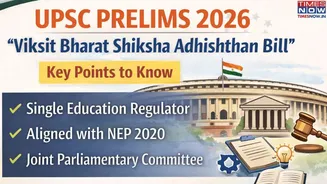

Union Education Minister Dharmendra Pradhan on December 13 introduced the ‘Viksit Bharat Shiksha Adhishthan Bill’ in Lok Sabha. Under this new proposed
Bill, the Ministry of Education (MoE) is proposing setting up a joint regulatory education body that will be replacing the existing three main regulators, namely UGC, AICTE and NCTE. On Tuesday (December 16), the Lok Sabha adopted a resolution to refer a Bill to a joint committee of Parliament. The joint committee will comprise 21 members of the Lok Sabha and 10 from the Rajya Sabha. This committee has been asked to submit its report by the last day of the first part of the Budget Session, 2026. Here are the key points UPSC aspirants should know about the ‘Viksit Bharat Shiksha Adhishthan Bill’
Objective & Vision
- The Bill aims to create a dedicated joint education regulator that aligns with the vision of Viksit Bharat (Developed India).
- This joint regulator will be headed by a chairperson appointed by the President of India.
- This regulator will cover all central universities and colleges under it, institutes of national importance functioning under the administrative purview of the Ministry of Education including IITs, NITs, IISc, IISERs, IIMs, and IIITs.
- Medical and law colleges will not be brought under this new regulatory body.
- Funding will not be handed over to this regulatory body as of now.
- Aligns with National Education Policy (NEP) 2020
- Lok Sabha adopted a resolution to refer a Bill to a joint committee of Parliament.
- This bill was earlier known as the 'Higher Education Commission of India (HECI) Bill'
UPSC Relevance (GS Papers)
- GS Paper II: Government policies, education reforms, institutional mechanisms.
- GS Paper III: Human capital development, skill ecosystem, demographic dividend.
- Essay & Ethics: Education as a tool for social transformation and nation-building.
Sample Questions For UPSC Prelims
Q1. The primary objective of the Viksit Bharat Shiksha Adhishthan Bill is to:
A. Replace the National Education Policy, 2020
B. Establish a centralised body for education reforms aligned with Viksit Bharat vision
C. Regulate private educational institutions only
D. Introduce compulsory digital education nationwide
Answer: B
Q2. The Bill is most closely aligned with which of the following policy frameworks?
A. Digital India Mission
B. Skill India Mission
C. National Education Policy (NEP) 2020
D. New Industrial Policy
Answer: C
Q3. Which of the following themes is/are emphasised under the proposed Shiksha Adhishthan?
- Competency-based learning
- Innovation and research
- Industry–academia collaboration
A. 1 and 2 only
B. 2 and 3 only
C. 1 and 3 only
D. 1, 2 and 3
Answer: D
Q4. The Bill’s provisions are most relevant to which UPSC GS paper?
A. GS Paper I – Indian Society
B. GS Paper II – Governance and Social Justice
C. GS Paper III – Environment
D. GS Paper IV – Ethics
Answer: B
Q5. From a development perspective, the Bill primarily seeks to strengthen:
A. Defence preparedness
B. Fiscal federalism
C. Human capital and demographic dividend
D. Judicial reforms
Answer: C
GS-II Mains Question
Q. Discuss the significance of the Viksit Bharat Shiksha Adhishthan Bill in strengthening India’s education governance. (200–220 words)
(All questions/ answers generated through AI)