







What is the story about?
The Directorate General of Civil Aviation (DGCA) has issued a Standard Operating Procedure (SoP) for airlines after the World Health Organization (WHO)
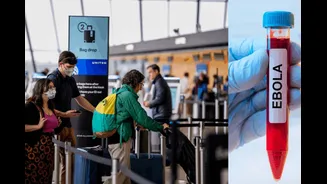
declared the Ebola outbreak in the Democratic Republic of Congo (DRC) and Uganda a Public Health Emergency of International Concern (PHEIC). Under the order issued on May 22, 2026, airlines operating direct or indirect flights connected to Uganda and the DRC must collect mandatory Self-Declaration Forms (SDFs) from all passengers arriving from, or transiting through, affected countries before they disembark in India. The DGCA also noted that neighbouring nations, including South Sudan, are considered high-risk zones for possible Ebola transmission.
Key Airline Measures Mandated by DGCA
Passenger Declarations and Announcements
What Airlines must ensure:
- Ensure all relevant passengers complete and submit Self-Declaration Forms before de-boarding.
- Make mandatory in-flight announcements informing passengers about Ebola symptoms such as fever, weakness, muscle pain, vomiting, diarrhoea, rash, or bleeding.
- Advise travellers to immediately report symptoms to cabin crew or airport medical authorities.
- Inform passengers that symptoms developing within 21 days of arrival should be reported to designated hospitals and airport health authorities.
Specific in-flight announcement:
In view of the current threat of Ebola disease in certain countries, any traveller who has fever, weakness, muscle pain, headache, sore throat, vomiting, diarrhoea, rash, bleeding, should report immediately to the airlines crew and at the immigration/medical unit on arrival. This is important for early diagnosis for prompt management and preventing spread., the DGCA said.
Protocol for suspected Ebola cases onboard
If a passenger shows Ebola-like symptoms during a flight, airlines must:
- Assign one cabin crew member exclusively to assist the passenger.
- Shift the passenger to the rear of the aircraft wherever possible.
- Keep three surrounding rows vacant to limit exposure.
- Reserve a dedicated washroom for the suspected patient.
- Provide masks and personal protective equipment (PPE) to the passenger and nearby travellers.
- Fully disinfect the aircraft after landing.
- Share details of the suspected case, nearby passengers, and attending crew members with the Airport Health Organisation (APHO) for 21-day monitoring.
What Airlines Are Required To Do in India:
- Coordinate with Air Traffic Control (ATC) to park affected aircraft in isolated bays.
- Ensure asymptomatic passengers disembark first, while the suspected patient and caregiver leave last under supervision of health officials.
- Assist APHO authorities with thermal screening and collection of declaration forms.
Crew preparedness and onboard supplies
The DGCA has instructed airlines to conduct focused health-safety training for crew members and ensure aircraft carry:
- First-aid and Universal Precaution Kits as per ICAO norms
- Triple-layer masks
- PPE kits
- Gloves
- Hand sanitizers
- Biohazard disposal bags
The measures are aimed at preventing Ebola transmission through international air travel while strengthening surveillance and emergency response at Indian airports.