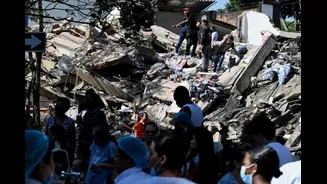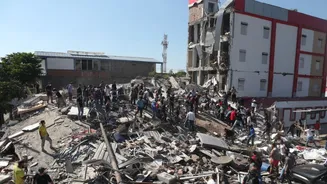






Bogota: A powerful earthquake has killed at least 132 people in western Colombia, leaving a trail of destruction across the region. Buildings and hospitals
were damaged, infrastructure was hit and several people were reportedly trapped under debris after the tremor. The 7.4-magnitude quake struck at around 7:34 am local time on Monday, according to the US Geological Survey. Its epicentre was recorded at a depth of 107 kilometres. Colombia’s Geological Service described it as the strongest earthquake recorded in the country during the 21st century. The disaster comes shortly after right-wing lawyer Abelardo De La Espriella took oath as Colombia’s president. The region has also been dealing with a series of deadly seismic events, including twin earthquakes that struck neighbouring Venezuela in June and reportedly killed more than 6,000 people. Earthquakes are a recurring threat a cross Latin America, which lies along several major tectonic boundaries. Over the centuries, some of the region’s earthquakes have caused catastrophic loss of life. Here are 10 of the deadliest:
1. Haiti, 2010 — 316,000 dead
Magnitude: 7.0
The earthquake that struck Haiti in January 2010 became one of the deadliest natural disasters in modern history.
Port-au-Prince, the densely populated capital, bore the brunt of the destruction. Many structures were unable to withstand the shaking, while limited emergency services made the aftermath even more devastating.
The disaster caused an estimated $8 billion in economic losses, roughly equivalent to 120% of Haiti’s GDP in 2009.
2. Ecuador-Colombia, 1868 — 70,000 dead
Magnitude: 7.7
A sequence of powerful tremors devastated parts of Ecuador and Colombia in August 1868.
Historical estimates put the combined death toll at around 70,000, including approximately 40,000 deaths in Ecuador and 30,000 in Colombia.
Ibarra was among the worst-hit areas. A government commission later described the scale of the destruction, writing: "In less than three seconds (Ibarra) was turned into a large and dismal burial ground. Almost all of its population buried under the ruins of their own bedrooms."
3. Peru, 1970 — 66,794 dead
Magnitude: 7.9
The earthquake off Peru’s coast set off a chain of events that proved even more deadly than the initial shaking.
A huge section of a mountain collapsed, sending a torrent of rock and glacial ice towards settlements including Yungay and Ranrahirca. The debris travelled at speeds of up to 335 kmph (208 mph).
Yungay was almost completely buried. Around 19,000 people died there, while only about 2,500 survived.
The disaster destroyed or severely damaged several other communities and left nearly one million people homeless.
4. Ecuador, 1797 — 40,000 dead
Magnitude: 8.3
One of the strongest earthquakes ever documented in Ecuador struck in 1797 and devastated large parts of the country.
Riobamba, Quito, Latacunga and Ambato were among the affected areas. Landslides added to the destruction, while historical accounts describe buildings collapsing within seconds of the ground beginning to shake.
The event remains the deadliest earthquake in Ecuador’s recorded history.
5. Chile, 1939 — 30,000 dead
Magnitude: 8.3
Chile is home to the strongest earthquake ever recorded, the magnitude 9.5 Valdivia earthquake of 1960. However, the country’s highest earthquake death toll came from an earlier disaster.
The 1939 earthquake devastated Chillan and Concepcion, killing around 30,000 people.
Seismologist Cinna Lomnitz pointed to poor construction as a major factor, citing the "virtual absence of engineering design or provisions against lateral force."
The destruction eventually prompted Chile to introduce its first anti-seismic building regulations.
6. Venezuela, 1812 — 26,000 dead
Magnitude: 7.7
The 1812 Venezuela disaster was not necessarily a single earthquake. A later analysis suggested that three separate earthquakes, occurring close together, may have been connected.
Caracas suffered extensive destruction, with around 90% of the city reportedly damaged. Other badly affected locations included Barquisimeto, Merida, La Guaira and San Felipe.
The earthquake occurred during Venezuela’s war of independence from Spain. Spanish authorities portrayed the catastrophe as punishment for the revolution.
The United States responded by sending food and money, marking an early instance of international disaster assistance to Venezuela.
7. Arica, 1868 — 25,000 dead
Magnitude: 8.5
The massive 1868 earthquake struck Arica when the city was still part of Peru. It caused extensive destruction across several cities, including Arequipa, Moquegua, Mollendo and Ilo.
But the earthquake was followed by another major threat: a tsunami.
The resulting waves devastated coastal settlements and travelled across the Pacific, reaching Hawaii and New Zealand.
8. Guatemala, 1976 — 23,000 dead
Magnitude: 7.5
A magnitude 7.5 earthquake struck Guatemala in the early hours of February 4, 1976, when most people were asleep.
The devastation spread across roughly 100,000 square kilometres, with adobe homes among the structures that collapsed.
Aftershocks added to the death toll, while approximately 1.2 million people were left without homes. Around 40% of Guatemala’s hospitals were also destroyed.
9. Venezuela, 1797 — 16,000 dead
Magnitude: Not available
The 1797 earthquake devastated Cumana and surrounding areas, killing an estimated 16,000 people.
Among those who later recorded accounts of the disaster was German explorer and naturalist Alexander von Humboldt.
Historical descriptions from the period mention strange sounds and other phenomena before the shaking. An 1855 earthquake catalogue recorded reports that "flames came up from the earth, followed by a subterranean noise like bubbling, and then (followed) by shocks" near the Bay of Cariago.
10. Argentina, 1861 — 14,000 dead
Magnitude: Not officially recorded
Mendoza was devastated when a powerful earthquake struck shortly before midnight in 1861.
Much of the city was destroyed, including the San Francisco Basilica. Fires then spread through the ruins, fuelled by the gas lamps commonly used at the time.
The fires continued for days, while the destruction was followed by widespread looting.
The Significant Earthquake Database does not assign a magnitude to the event. Other historical estimates, however, place it at around 7.2 magnitude.
(Data compiled from the National Centers for Environmental Information and World Data Service for Geophysics Significant Earthquake Database.)