







The Central Board of Secondary Education (CBSE) has rolled out its new three-language policy in line with the National Education Policy (NEP) 2020, but
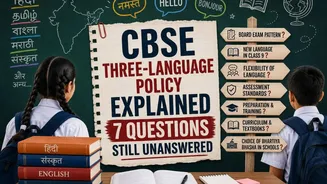
the implementation has been marked by confusion, controversy and repeated course corrections. The rollout was so muddled that the audit/review committee constituted to examine the CBSE guidelines termed it an abrupt introduction. The Supreme Court also pulled up the Board over the implementation, following which Education Minister Dharmendra Pradhan assured parents that the policy would be introduced in a phased manner, beginning with Class 6. Now, CBSE has issued a fresh circular that appears to differ from those earlier assurances. Under the latest guidelines, the three-language policy will be implemented for students from Classes 6 to 9, albeit with certain relaxations. Here's a simple explainer on what the new circular means for students and parents, what has changed, and the questions that still remain unanswered. We have sought clarifications from CBSE on these issues and will update this story as soon as we receive a response. What is the CBSE three-language policy? Under the new policy, every student will study three languages - two Bhartiya Bhashas (Indian languages) and one non-native (foreign) language. From which class will the policy be implemented? The policy will apply from Class 6 onwards. However, as a transition measure, it is also being implemented for students currently studying in Classes 7, 8 and 9 starting this academic year. Is English considered a foreign language now? Yes. Under the new CBSE framework, English is treated as a non-native language. It is not mandatory, provided the student fulfils the requirement of studying two Bharatiya Bhashas. Which Indian languages can students choose? The CBSE circular has give some examples of Bharatiya Bhashas that include Hindi, Sanskrit, Tamil, Telugu, Kannada, Malayalam, Marathi, Bengali, Punjabi, Gujarati, Odia, Assamese and other Indian languages recognised by CBSE. Which non-native languages can students choose? Students may choose from languages such as English, French, German, Arabic, Spanish and other languages offered by their school. What if a current Class 9 student is already studying two Indian languages? Students already studying two Bhartiya Bhashas will now need to opt for one non-native language to complete the three-language requirement. What if a current Class 9 student is studying one Indian language and one non-native language? Such students will need to add another Bhartiya Bhasha in Class 9. What if a current Class 9 student is studying only non-native languages, such as English and German? Students who are not studying any Bhartiya Bhasha must choose an Indian language in Class 9. They will undergo a school-based internal assessment in that language and will be required to pass it. What happens if a Class 9 student fails the third language (R3)? If a current Class 9 student does not qualify the school-based assessment of the third language (R3), the student will still be promoted to Class 10 for the 2027–28 academic session, however, the student must clear the pending Class 9 R3 assessment while studying in Class 10. Will the third language become a CBSE Board exam subject in Class 10? No. The third language (R3) will not be a CBSE Board examination subject when the current Class 9 batch moves to Class 10 in 2027–28. It will continue to be assessed internally by schools. Can current Class 9 students choose which language becomes R3? CBSE has clarified that students will continue with the same three-language combination they studied in Class 8. From these three languages, one language will be designated as R3 for school-based assessment. However, it is not fully clear if the student will be allowed to choose that. What changes for current Class 7 and Class 8 students? Students currently in Classes 7 and 8 who have already chosen two non-native languages will now have to study one Bharatiya Bhasha and continue it till Class 10. Like the current Class 9 batch, the third language (R3) will be assessed only through an internal school-based assessment. There will not be a CBSE Board examination for R3 when these students reach Class 10 and the same assessment and promotion rules applicable to the current Class 9 batch will also apply to these students. This transition is intended to align all students with the NEP 2020 language framework while ensuring that the additional language is assessed internally rather than through the Class 10 Board examination.
QUESTIONS THAT STILL NEED ANSWERS FROM CBSE
- What will the Class 10 Board examination pattern look like once the policy is fully implemented? Will students have to take one Bharatiya Bhasha and one non-native language, or will they be free to choose any two languages from the three they study?
- Is it realistic to expect a current Class 9 student to learn an entirely new 'Indian native language' within a year?
- If a Class 9 student is learning Sanskrit for the first time, what curriculum will they follow? Will they be assessed on an introductory syllabus similar to students who began studying the language in Class 6?
- What happens to students who wish to study two non-native languages, such as English and German, because it aligns with their higher education or career goals? Will CBSE provide any flexibility or exemptions?
- What if a student wants to study a particular 'native Indian language' that their school does not offer? Shouldn’t CBSE first ensure schools have the capacity to offer multiple 'native Indian languages'? Without trained teachers and adequate resources, will students simply be limited to whichever Indian language their school happens to offer?
- How long has CBSE been preparing for this transition? Have textbooks, teacher training modules and curriculum frameworks been developed well in advance or will schools be expected to implement the changes on short notice?
- How will CBSE ensure uniformity in school-based assessments (R3)? Since there is no Board examination, what safeguards will ensure that assessment standards are consistent across schools?
TIMES NOW | OPINION
While there are valid concerns around the policy announcement and its practical implementation, it is important for CBSE to address not just schools but also parents and students, who will be most affected by the change. Promoting Indian languages (Bhartiya Bhasha) is a positive step and the intent behind the policy is difficult to dispute. The real question, however, is whether it can be implemented smoothly and fairly. Ideally, such a reform should have been introduced from the foundational grades, allowing children to learn the language progressively and grow within the system rather than being expected to adapt midway through their schooling.