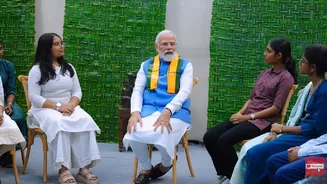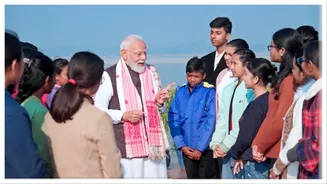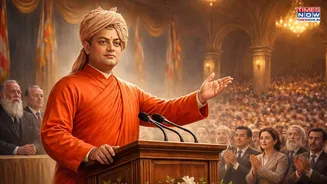

While interacting with students in the latest episode of Pariksha Pe Charcha, Prime Minister Narendra Modi cited an example of Swami Vivekananda. When
asked how to improve confidence while speaking publicly, PM Modi said, "Atma-Vishwas is important; if you have faith in yourself, you can overcome any challenge. A person who has self-confidence analyses situations internally and reflects on their own abilities." PM Modi further narrated to the students how Swami Vivekananda wrote a letter to one of his students after delivering his historic speech in Chicago. In the letter, he wrote, “I became very nervous before delivering my speech in Chicago. I kept thinking that so many intelligent people were present—what would I say in front of them? Then I prayed to Maa Saraswati and said, ‘Mother, awaken all the strength that is within me. Let everything that I have learned come to my tongue at once.’ After praying, I went on to the stage. When I said, ‘Sisters and brothers of America,’ the audience applauded for two minutes. That moment became the turning point of my life. I gained confidence. I realised that even I could do something—that I had something within me. That is when atma-vishwas (self-confidence) awakened in me.” Students can test their knowledge about Swami Vivekananda and his famous Chicago speech by answering the quiz questions mentioned below. The full text of the speech has been attached at the end for their reference.
Quiz Questions and Answers Around Swami Vivekananda
1. Where did Swami Vivekananda deliver his famous speech in 1893?
A. London
B. Chicago
C. New Delhi
D. Paris
2. What were the opening words of Swami Vivekananda’s speech?
A. Dear friends
B. Respected guests
C. Sisters and brothers of America
D. Honoured teachers
3. What main message did Vivekananda give about religions?
A. Only one religion is true
B. All religions should fight
C. All religions should be respected
D. Religion is not important
4. Which three things did Vivekananda say harm the world?
A. Hunger, poverty, illness
B. Sectarianism, bigotry, fanaticism
C. Games, travel, trade
D. Science, education, progress
5. Which holy book did Vivekananda mention in his speech?
A. Ramayana
B. Mahabharata
C. Bhagavad Gita
D. Vedas
Answer key:
1. B
2. C
3. C
4. B
5. C
Interesting Facts About Swami Vivekananda
- Swami Vivekananda was born on 12 January 1863. His birthday is celebrated as National Youth Day in India.
- His real name was Narendranath Datta.
- He believed that all religions should be respected and taught people to live in peace.
- He loved and guided young people and told them to believe in themselves.
Swami Vivekananda Chicago speech
It fills my heart with joy unspeakable to rise in response to the warm and cordial welcome that you have given us. I thank you in the name of the most ancient order of monks in the world, I thank you in the name of the mother of religions, and I thank you in the name of millions and millions of Hindu people of all classes and sects.My thanks, also, to some of the speakers on this platform who, referring to the delegates from the Orient, have told you that these men from far-off nations may well claim the honor of bearing to different lands the idea of toleration. I am proud to belong to a religion that has taught the world both tolerance and universal acceptance. We believe not only in universal toleration, but we also accept all religions as true. I am proud to belong to a nation that has sheltered the persecuted and the refugees of all religions and all nations of the earth. I am proud to tell you that we have gathered in our bosom the purest remnant of the Israelites, who came to Southern India and took refuge with us in the very year in which their holy temple was shattered to pieces by Roman tyranny. I am proud to belong to the religion that has sheltered and is still fostering the remnant of the grand Zoroastrian nation. I will quote to you, brethren, a few lines from a hymn that I remember having repeated from my earliest boyhood, which is every day repeated by millions of human beings: “As the different streams having their sources in different paths that men take through different tendencies, various though they appear, crooked or straight, all lead to Thee.”
The present convention, which is one of the most august assemblies ever held, is in itself a vindication, a declaration to the world of the wonderful doctrine preached in the Gita: “Whosoever comes to Me, through whatsoever form, I reach him; all men are struggling through paths which in the end lead to me.” Sectarianism, bigotry, and its horrible descendant, fanaticism, have long possessed this beautiful earth. They have filled the earth with violence, drenched it often and often with human blood, destroyed civilization and sent whole nations to despair. Had it not been for these horrible demons, human society would be far more advanced than it is now. But their time is come; and I fervently hope that the bell that tolled this morning in honor of this convention may be the death-knell of all fanaticism, of all persecutions with the sword or with the pen, and of all uncharitable feelings between persons wending their way to the same goal.