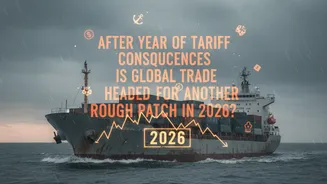








The year 2025 reshaped global trade in ways few had anticipated, pushing the world economy into a new and uncertain phase. While global commerce showed
surprising resilience despite rising protectionism, the aftershocks of aggressive tariff policies are now expected to hit harder in 2026. For traders, policymakers and shipping companies alike, the coming year may prove far more challenging than the last. Trade Holds Up in 2025: But With Clear Fault Lines Despite a sharp escalation in US tariffs under President Donald Trump, global merchandise trade managed to avoid a collapse in 2025. Data cited by shipping industry veteran John McCown shows that global container volumes rose 2.1% year-on-year in October, according to Bloomberg. However, the headline numbers mask deep regional divergences. Container imports into the United States fell sharply by 8%, while trade flows into Africa, the Middle East, Latin America and India grew strongly. This suggests that global supply chains are already adjusting, redirecting volumes away from the US and towards faster-growing markets. McCown noted that global shipping networks are “reconfiguring trading patterns” in response to tariffs. After a powerful rebound in 2024 — when US container imports surged 15.2%, the contrast in 2025 could not be starker. Much of this shift, analysts say, can be traced directly to US trade policy. From Tariff Announcements to Tariff Consequences According to McCown, if 2025 was the year when tariffs were announced and imposed, 2026 will be the year when their full economic consequences are felt. Trade experts point to several emerging stress points that could shape global commerce in the year ahead. One of the most closely watched is the scheduled review of the United States–Mexico–Canada Agreement (USMCA), which comes into force just six years after its launch — unusually early for a major trade pact. US Trade Representative Jamieson Greer told lawmakers that more than 1,500 submissions were received during the public consultation process. While many stakeholders support extending the agreement, nearly all have called for changes. Any renegotiation is likely to be contentious, as gains for one country could come at the expense of another. Industries in Canada and Mexico are already under pressure from US tariffs, while political relations remain strained. Tensions escalated further in October when President Trump abruptly halted trade talks with Canada after anti-tariff advertisements featuring former president Ronald Reagan appeared north of the border. Shipping Faces Fresh Disruptions Beyond trade policy, global shipping faces risks from developments that would normally be considered positive. One such factor is the gradual return of cargo vessels to the Red Sea and the Suez Canal. For nearly two years, shipping lines had avoided the route due to attacks by Houthi forces, rerouting vessels around southern Africa instead. Since a Gaza peace plan took effect in October, security conditions have improved, prompting companies like CMA CGM and Maersk to resume limited transits. However, a full-scale return could overwhelm ports and infrastructure. Lars Jensen, CEO of consultancy Vespucci Maritime, warned that a sudden surge in capacity could flood European ports, triggering severe congestion and logistical bottlenecks. A second risk lies in stronger demand. If the US economy accelerates in 2026, as the Trump administration predicts — supported by lower interest rates and higher investment — a wave of inventory restocking could strain shipping capacity beyond its limits. Fragile Trade Deals and Rising Geopolitical Strains Uncertainty also surrounds the durability of trade agreements announced by the US in 2025. Unlike traditional trade pacts, many of these deals lack strong enforcement mechanisms and rely on short-term commitments. The truce with China, for instance, runs for just one year, leaving the most imbalanced trade relationship unresolved. Recent developments have added to concerns. Indonesia has resisted US trade demands despite Washington calling their July agreement “landmark,” citing fears over loss of policy autonomy. China has warned Malaysia and Cambodia against aligning too closely with US trade terms, while the UK has faced fresh complications in its negotiations. Greer has acknowledged that difficult talks with both the European Union and India are likely to spill into 2026. His office has also hinted at possible retaliation against the EU, particularly over regulations affecting American technology firms. Legal Uncertainty Adds Another Layer of Risk Adding to the unpredictability is a pending US Supreme Court ruling on the legality of Trump’s reciprocal tariffs. A decision against the administration could raise questions about whether importers are entitled to refunds for duties already paid. However, White House officials have downplayed that possibility. Kevin Hassett, director of the National Economic Council, said widespread refunds would be “pretty unlikely” due to the administrative burden. Betting markets currently assign around a 75% probability that Trump will lose the case — a scenario that could push the administration to seek alternative legal routes to maintain tariffs. A Volatile Year Ahead As 2026 approaches, global trade stands at a delicate crossroads. Supply chains are shifting, trade agreements are under strain, and legal and geopolitical risks are multiplying. What appeared manageable in 2025 could become far more disruptive as the real economic impact of tariffs takes hold. For businesses and governments alike, the message is clear: the era of tariff announcements may be over, but the era of tariff consequences is only just beginning.