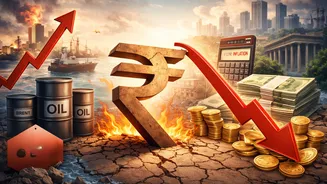









Goldman Sachs has further lowered its expectations for India’s economic expansion in 2026, warning that rising oil prices and currency weakness could weigh
heavily on the nation's growth. The revised outlook also points to tighter monetary policy ahead, with the investment bank anticipating an interest rate hike as inflation risks build. In its latest assessment, Goldman Sachs now projects India’s economy to expand by 5.9 per cent in calendar year 2026, a notable downgrade from its earlier estimate of 7 per cent made before the Iran-related geopolitical tensions escalated. This marks the second downward revision in a short span, after the bank had already trimmed its forecast to 6.5 per cent on March 13. The downgrade reflects shifting assumptions around global energy markets, particularly the impact of supply disruptions and elevated crude oil prices. For a country like India, which relies heavily on energy imports, such developments pose significant macroeconomic challenges. Oil Prices And Supply Disruptions Add Pressure On GDP A key factor behind the revised outlook is the expected disruption in oil flows through the Strait of Hormuz. Goldman now believes the near-shutdown could persist until mid-April, with normalisation taking another month thereafter. As a result, Brent crude prices are projected to average $105 per barrel in March and rise further to $115 in April. Prices are expected to ease later in the year, falling to around $80 per barrel in the fourth quarter. However, the near-term spike is likely to strain India’s fiscal balance, push up inflation, and pressure foreign exchange reserves. Inflation And Rate Hike Outlook Goldman Sachs has also raised its inflation forecast for India in 2026 to 4.6 per cent, up from its earlier estimate of 3.9 per cent. While still within the Reserve Bank of India’s tolerance band of 2-6 per cent, the increase signals mounting price pressures. To counter these risks, the bank expects a 50 basis point hike in the policy repo rate. A weakening rupee is another concern, with the currency already declining 4 per cent against the US dollar so far this year, after a 4.7 per cent drop in 2025. According to Goldman, the pass-through effect of currency depreciation on consumer prices could be significant. The report also flags concerns about India’s external position. Goldman estimates that the current account deficit could widen to 2 per cent of GDP in 2026. This compares with 1.3 per cent recorded during the October-December quarter of 2025, indicating a potential deterioration driven by higher import costs and currency pressures.