
The recently released University Grants Commission (UGC) equity guidelines are now in controversy. The 2026 regulations tweaked 2012 norms and included
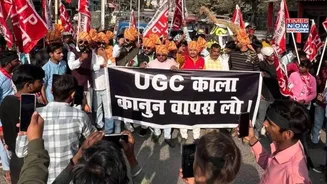
the Other Backward Classes (OBCs) under anti-discrimination protections along with SCs and STs. This change has sparked strong reactions on campuses and in political circles. The students from upper-caste communities called for a protest outside the UGC headquarters in Delhi today (January 27), saying that the new regulations issued by the commission could lead to chaos on campuses. The new regulations expanded its earlier anti-discrimination framework and widened the scope of who can seek protection under the rules. "The new regulations are draconian in nature. The definition of victim is already predetermined. Victim can be anyone in the campus," Alokit Tripathi, a PhD student from Delhi University (DU) told PTI. "The new regulations are draconian in nature. The definition of victim is already predetermined. Victim can be anyone in the campus. With the proposed Equity squads, it will be akin to living under constant surveillance inside the campus." A Public Interest Litigation (PIL) has been filed in the Supreme Court against the UGC's newly issued equity regulations, even as protests and objections continue on campuses across the country. The rules, notified earlier this month as the UGC (Promotion of Equity in Higher Education Institutions) Regulations, 2026, aim to strengthen safeguards against discrimination in colleges and universities.
What are the guidelines?
- The rules define discrimination in a broad way. Any unfair treatment based on caste, religion, gender, disability, race, place of birth or similar identity factors is covered. Both open and indirect discrimination are included.
- All colleges and universities must set up an Equal Opportunity Centre (EOC). These centres will handle complaints, keep track of discrimination issues, and promote inclusion on campus.
- Each EOC must have an Equity Committee. The committee must include members from SC, ST, OBC communities, women, and persons with disabilities.
- Institutions must create proper systems to receive and resolve discrimination complaints. Regular monitoring and internal reporting are mandatory.
- Vice-chancellors (V-Cs) and principals will be responsible for making sure the rules are followed and for submitting reports to the UGC.
- Institutions that fail to follow them may face penalties, including loss of approvals, exclusion from UGC schemes, or even withdrawal of recognition.
Leaders have argued that the guidelines could be misused by anyone. Many have raised concerns over the institutes’ capacity to implement the rules fairly.
On the new UGC anti-discrimination rules, BJP MP Manan Kumar Mishra says, "The UGC officials made a decision without clear reasoning, which benefits no one. Dividing people on the basis of caste is wrong. There should be equal treatment for everyone in colleges and institutions. If something is banned, it should be banned for all. I believe the government should take note of this, or the UGC should review it itself..."
Meanwhile, a plea has also been filed in the Supreme Court challenging a recently notified UGC regulations alleging that it has adopted a non-inclusionary definition of caste-based discrimination and excludes certain categories from institutional protection. The plea, filed by Vineet Jindal, submitted that regulation 3(c) of the recently notified UGC (Promotion of Equity in Higher Education Institutions) Regulations, 2026 is "non-inclusionary" and fails to protect students and faculty who do not belong to reserved categories.
What happens next?
Now all the UGC-recognised institutions will have to implement the regulations with immediate effect. Under the new rules, vice-chancellors, principals, and heads of institutions are directly responsible for preventing and responding to discrimination. Their role will now expand from administrator to the person responsible for accountability.
UGC Equity Guidelines 2026: FAQs for Students
Question 1: What changed in the 2026 rules?
Answer 1: The biggest change is that Other Backward Classes (OBCs) have been clearly included under anti-discrimination protections, along with Scheduled Castes (SCs) and Scheduled Tribes (STs). The rules also make compliance mandatory and legally enforceable, unlike earlier advisory guidelines.
Question 2: What is meant by “discrimination” under these rules?
Answer 2: Discrimination is defined broadly. It includes any unfair treatment based on caste, religion, gender, disability, race, or place of birth. Both direct discrimination (open acts) and indirect discrimination (hidden or structural bias) are covered.
Question 3: Do these rules apply to academic disputes or exam-related issues?
Answer 3: No, general academic disputes are excluded unless they involve identity-based discrimination.
Question 4: How can students file a complaint?
Answer 4: Students can submit complaints: online, by email, in writing, through a 24-hour Equity Helpline.
Question 5: What will the committee do?
Answer 5: The Equity Committee must meet within 24 hours and submit a report within 15 working days.
Question 6: What happens if a complaint involves a criminal offence?
Answer 6: If a complaint reveals a possible criminal offence, it will be forwarded to the police. This links campus procedures directly to the criminal justice system.
Question 7: Has the issue reached the courts?
Answer 7: Yes, a Public Interest Litigation (PIL) has been filed in the Supreme Court challenging the regulations. Another plea argues that the rules are “non-inclusionary” and fail to protect students from non-reserved categories.
Question 8: What happens next?
Answer 8: All UGC-recognised institutions must implement the rules immediately. However, if there are any changes in the regulations due to the ongoing protests is yet to be seen.