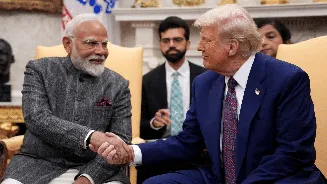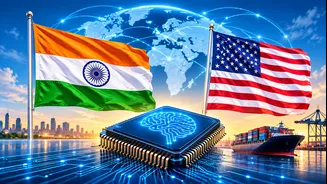








India has joined the US and several other nations in signing the San Francisco Declaration on the Secure Foundations of Enduring Prosperity, a move aimed
at safeguarding critical technologies and AI supply chains amid intensifying competition with China as per the Financial Times. According to the Financial Times, US Under-Secretary of State for Economic Affairs Jacob Helberg said that India, along with South Korea, Qatar and the United Arab Emirates, had signed the declaration, while Germany, Sweden, the Netherlands and the European Commission were expected to sign it the following week. The agreement, signed by the US and its partners, including Japan, Australia, Israel and the United Kingdom, seeks to establish a joint list of critical technologies and supply chains underpinning AI that require greater protection. The initiative is part of Pax Silica, a US-led effort to strengthen AI-related supply chains, spanning semiconductors, critical minerals, energy and advanced manufacturing, as Washington and its partners seek to enhance cooperation amid increasing competition and economic pressure from China. Explaining the significance of the agreement, Helberg told the Financial Times that AI supply chains are spread across multiple countries, making international cooperation essential for their security. "The know how to design a chip, the machine that makes it and the port that ships it can all be in different countries," Helberg said. "What makes the San Francisco Declaration historic is that Pax Silica partners have agreed to treat the security of those technologies and the infrastructure behind them as a shared responsibility," he added. Debraj Banerjee, General Partner, F2A (Fundamentum Frontier Advisors) told Times Now Digital, "India signing the San Francisco Declaration shows that AI is now as much about supply chains as algorithms. Being a trusted partner is a good start, but India should use this seat to ask for three things. First, guaranteed access to advanced AI chips and compute, without caps or case-by-case licences. Second, a defined role in the chain itself: chip design, packaging and testing, and critical-minerals processing, not just being a buyer. Third, co-investment and technology sharing for Indian chip and edge-AI startups. Otherwise we only switch who we depend on, rather than reducing that dependence."