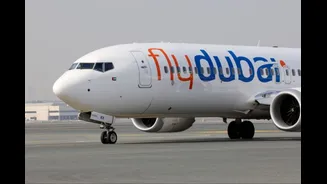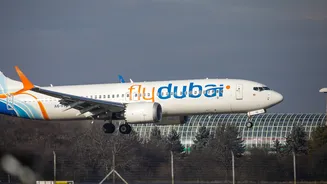









Just hours after a Flydubai flight from Dubai to Tel Aviv was forced to make an emergency landing in Saudi Arabia on Wednesday, yet another flight was reported
to have turned back, as per media reports. In the earlier incident, an onboard incident triggered distress signals and briefly raised fears of a hijacking, according to Israeli officials and flight-tracking data. All passengers were reported safe. The incident involved Flydubai flight FZ1073, a Boeing 737 operating the popular Dubai-Tel Aviv route. The aircraft was flying over Jordanian airspace when it transmitted emergency alerts and abruptly changed course towards Saudi Arabia. The plane eventually landed safely at Tabuk airport in northwestern Saudi Arabia. Initial reports sparked concerns in Israel that the aircraft may have been hijacked. Flight-tracking data showed the aircraft transmitting a general emergency code before sending another signal associated with possible unlawful interference. The plane also made a rapid descent of nearly 14,000 feet in less than 30 seconds before stabilising. However, Israeli officials later said the diversion was not linked to a hijacking. Instead, the emergency appears to have stemmed from an alleged physical altercation between the pilots in the cockpit. An Israeli official told Reuters that the distress signals were transmitted after the pilots became involved in a confrontation during the flight. Flydubai confirmed that the aircraft experienced an “incident” while en route to Tel Aviv but did not provide further details. The airline said the plane landed safely in Tabuk and that all passengers were accounted for. Passenger accounts added to the confusion surrounding the episode. Some passengers reportedly described hearing screams and witnessing a disturbance near the cockpit. Israeli media cited accounts suggesting passengers intervened after a confrontation involving crew members. These accounts have not been independently verified. The incident prompted a major security response in Israel. Israeli authorities initially treated the situation as a potential aviation security threat, and reports said fighter jets were scrambled as officials monitored the flight's movements. The Prime Minister's Office later said the situation was under control and that efforts were underway to return passengers safely to Israel. The episode comes at a sensitive time in the region. Direct commercial links between the United Arab Emirates and Israel were established following the Abraham Accords in 2020, leading to multiple daily flights between Dubai and Tel Aviv. The route has become one of the busiest air corridors connecting the two countries and is widely used by Israeli travellers. Saudi Arabia does not have formal diplomatic relations with Israel, making the emergency landing particularly notable. However, Saudi authorities have permitted Israeli-bound commercial aircraft to use their airspace since 2020, allowing such flights to operate on shorter routes across the region. The latest incident is not the first emergency diversion involving a UAE-Israel flight. A Flydubai service travelling between Dubai and Tel Aviv made an emergency landing in Saudi Arabia in 2025 because of a medical emergency. Saudi, Emirati and Israeli authorities are expected to investigate Wednesday's incident, including the circumstances surrounding the reported cockpit altercation and the emergency signals transmitted during the flight.