





What is the story about?
Tom McGee, a 69-year-old market researcher from near Chicago, began climbing stairs for exercise two decades ago to avoid cigarettes. Despite his dedication,
he often faces scrutiny from security guards in hotel stairwells. Stair climbing has gained recognition in exercise guidelines, yet many enthusiasts report difficulties accessing stairwells due to restrictions imposed by building managers and owners.
Stair Climbing: A Beneficial Workout
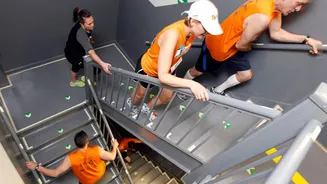
Dr. Luis Rodriguez, a semi-retired pediatric pulmonologist, actively participates in stair-climbing events and emphasizes the numerous health benefits associated with this exercise. He states, “You are working your legs. You are working your heart. You are working your lungs.” Rodriguez explains that climbing stairs can provide greater benefits than merely walking, as it challenges the body against gravity.Research supports this claim, indicating that four minutes of stair climbing is roughly equivalent to ten minutes of brisk walking. In 2018, updated federal physical activity guidelines encouraged short-burst activities, such as utilizing stairs whenever possible, to enhance overall health.
Many individuals are unaware that effective exercise does not require long, continuous sessions, according to Stella Volpe, an exercise expert at Virginia Tech. Additionally, stair climbing has been linked to improved mental health and increased energy levels, as noted by Jennifer Gay, a public health researcher at the University of Georgia.
Experts recommend that individuals with mobility concerns consult their doctors before beginning a stair climbing routine.
Building Owners View Stairs as Liabilities
The American Lung Association organizes fundraising stair-climbing events across the nation, known as the “Fight for Air,” which highlight the challenge of breathlessness many experience after ascending multiple floors. However, building owners often limit stair access due to liability concerns.Legal advisors warn that landlords may face liability if someone suffers an injury on stairs, prompting many building managers to restrict stair usage to emergency situations. A 2018 study revealed that over one million stair-related injuries occur annually in the U.S., with a higher incidence of broken bones among older adults.
Despite the perception of risk, research indicates that stair climbing itself carries minimal injury risk. Gay points out that descending stairs poses more danger, and building managers cannot enforce one-way access.
Health advocates have long pushed for better stair access, with a 2013 resource guide from ChangeLab Solutions arguing that stairwells do not present a greater liability risk than other common areas. Gay's research estimates that 60% of U.S. workers are employed in multistory buildings, but data on stair access restrictions remains unavailable.
Creative Solutions for Stair Climbing
Many stair climbing enthusiasts share experiences of struggling to find accessible staircases. Lisa Bai, a real estate professional in New York, notes that her office building does not allow stair use, making it challenging to incorporate this exercise into her routine.In the absence of accessible stairs, individuals often turn to fitness equipment like StairMaster machines, although participants in tower climbs assert that these alternatives do not replicate the stair climbing experience. Those without easy access to stairs at home or in public spaces may need to be inventive.
Carmen Erickson and Vivian Dawson, who reside in the Detroit suburbs, have been climbing stairs together three times a week for nearly ten years. When traveling, they opt for hotels on upper floors to utilize the stairs and seek out hills or hospital parking decks for additional climbing opportunities.
They have even arranged after-hours access to a building's stairwells by agreeing to a waiver and notifying security. Erickson, 53, states, “If you connect with the right people and tell them what they're doing and agree to the rules, it hasn't really been a problem for us.” Dawson, 64, adds, “You have to really want to do it.”