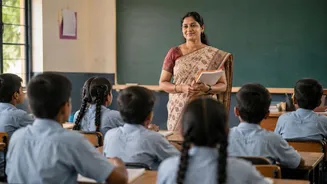








For one day every year, teachers get the spotlight. Schools hold assemblies, students write messages and social media fills up with photographs of favourite
teachers. By the next morning, however, teachers are back where they usually are: inside classrooms, navigating packed syllabi, paperwork, examinations and policies they are expected to implement. And that is where the real conversation begins. Speaking to Times Now Digital, teachers and education experts from schools and higher education institutions across the country have highlighted what they believe needs urgent attention. Their wish list is not about making education easier. It is about making it work better: fewer administrative burdens, meaningful assessment, better training, stronger industry-academia links, life skills in classrooms and a system that measures what students can actually do rather than merely what they can reproduce in an examination. The timing matters. Paper leaks and examination controversies, questions over assessment and results, the growing influence of artificial intelligence and the continuing implementation of the National Education Policy (NEP) 2020 have all brought the same question back into focus: how much of education policy is actually reaching the classroom? Teachers see that gap every day.
The answer sheet cannot be the whole story
India's dependence on examinations is hardly new. But when a score can determine a student's college, career path and, in many cases, years of preparation, the pressure around that score becomes enormous.
For Dr Poornima Gupta, Professor at Great Lakes Institute of Management, that is where the problem begins.
“Students need less standardised testing, more real learning,” she says.
“When education is shaped around test scores rather than genuine understanding, it leaves little room for creativity, critical thinking, or depth.”
The solution, however, is not to throw examinations out of the system.
Dr Chennakesava Rao, Principal Professor of Mechanical Engineering at VNRVJIET, believes they should sit alongside assessments that show what students can do with what they have learnt.
“Examinations remain important. Examinations should be complemented by projects, presentations, practical work, internships and problem-based learning,” he says.
“In engineering education, especially, students must be evaluated not on what they know but on how effectively they can apply that knowledge to solve problems and create solutions.”
That distinction becomes particularly important in classrooms where students are expected to prepare not just for an examination, but for a world that rarely gives them multiple-choice options.
Rati Chugh, Principal of Delhi Public School, Sector 45, Gurgaon, sees the role of teachers changing along with that world.
“Teachers have evolved with the passage of time. In today's day and age it is imperative to guide our students to adapt, analyse and work in tandem as team players. Their mere goal is not to pass an examination.”
Her larger point is about what education should look like beyond the traditional theory-versus-practical divide.
“An education policy must therefore move beyond the traditional divide between theory and practical; and create a more integrated learning ecosystem.”
And that, she says, starts with allowing students to ask questions.
“I believe children learn better with research, when they ask questions and solve day to day problems. This approach helps students move from simply acquiring knowledge to innovation.”
In other words, the answer sheet should not be the only place where a student gets to prove they can think.
But there is another problem lurking behind the examination debate. Students are often learning for two systems at once: school and competitive entrance examinations.
Educator Keshav Agarwal puts it plainly:
“Teachers want policymakers to bridge the widening gap between school education and competitive entrance examinations.”
He argues that India should move towards “One Nation, One Broad Curriculum Framework”, while allowing boards reasonable flexibility. Giving suitable weightage to Class 12 board marks in entrance examinations, he says, could also help restore the importance of school learning.
Then there is the issue that can undermine the entire examination ecosystem in one stroke: trust.
“The menace of paper leaks must end through stronger digital security, more CBT centres, accountability, independent audits and strict punishment,” Agarwal says.
He also calls for urgent reform of the Common University Entrance Test (CUET), arguing that its syllabus, schedule, difficulty level and admission process need to become more predictable and student-friendly.
And even a good reform can fail if schools are asked to implement it before they are ready.
“Curriculum changes should never be announced before textbooks, teacher-training material and assessment guidelines are ready. A reform is successful only when schools are fully prepared to implement it from the first day.”
NEP 2020 needs to reach the classroom
On paper, the direction is clear. The harder part is making it visible in an ordinary classroom.
Six years after NEP 2020 was approved, its larger promise remains clear: move education away from rote learning towards competency, critical thinking, flexibility and holistic development. But policies do not teach classes. Teachers do.
Dr Chennakesava Rao points to the practical challenge teachers face. “Teachers and institutions are often expected to implement initiatives while simultaneously managing academic, administrative and accreditation responsibilities,” he says.
“Policymakers need to recognise these realities and give institutions and faculty the flexibility and support required to translate reforms into outcomes for students.”
Prof. (Dr.) D. Subhakar, Vice Chancellor, Amity University Bengaluru, points to how the system is gradually moving away from a model designed for everyone in exactly the same way.
“For a long time there was a ‘one-size-fits-all’ approach in education. Thanks to the consistent efforts of the industry and government, we have policies such as NEP 2020.”
But a policy can only go as far as the people implementing it. For Subhakar, that makes teachers central to the next phase of reform:
“As the education ecosystem continues to reform and transform, teachers are at the heart of this shift. Their voices should be an important part of policy decisions as well as implementation.”
That requires more than asking teachers to adapt to every new initiative. They need the time and resources to do so.
“They need the right training, better access to technology, and enough time to focus on teaching rather than paperwork. Education policies should also give teachers the freedom to use new and practical ways of teaching based on the needs of their students.”
Anju Soni, Principal of Shiv Nadar School, Noida, makes the same case from the school side.
“We need to ensure that policy is grounded in the realities of the classroom. This requires greater coherence in the curriculum and assessment, fewer administrative requirements, and more time for teachers to teach, collaborate, reflect, and innovate.”
Teachers, she says, need “resources, training and autonomy to exercise professional judgement, respond to the needs of their learners and adapt their practice to changing contexts.”
It is a fairly straightforward proposition: if teachers are expected to deliver reform, they need to be given the space to make it work.
Subhakar sums up that expectation by saying, “When teachers are supported and empowered, they can create a better learning experience for every student.”
Teach children for life, not just the next exam
There is another casualty of the marks race: the things children need to know but cannot always put on an answer sheet.
Dr Poornima Gupta believes life skills should become a mandatory part of education from the primary level.
“It is also important to make it mandatory to teach life skills rather than just subjects,” she says, listing communication, financial literacy, empathy and environmental responsibility among the skills children should develop early.
For Manisha Pundir, HOD Social Sciences at VidyaGyan School, Sitapur, the purpose of education goes further than accumulating information.
“Education must go beyond the accumulation of knowledge. Its real purpose is to help students think critically, articulate their ideas with confidence, and engage meaningfully with the world around them,” Pundir says. That confidence, she believes, cannot be left to chance.
“We must also place greater emphasis on communication and articulation, embedding these skills into everyday classroom interactions so that every child develops the confidence to find and express their own voice,” she says.
For Pundir, education must also nurture “empathy, values and leadership alongside knowledge and skills”, preparing students not only for the future of work but also “for their role as responsible citizens.”
A marksheet can record academic performance. It cannot tell you whether a student knows how to listen, collaborate, question an idea or stand up for someone else.
School and higher education cannot operate in silos
The transition from school to college is often treated as automatic. Teachers see a problem in that assumption.
Chugh points to the need for continuity between the two stages.
“There is a pressing need for stronger synergy between school curricula and higher education, so that the skills and competencies developed in school continue to evolve seamlessly when our students step into the world outside,” she says.
If schools are encouraged to promote inquiry, collaboration and application while higher education remains heavily content-driven and examination-focused, that reform journey can lose momentum somewhere between the school gate and the university campus.
Praneet Mungali, Trustee of the Sanskriti Group of Schools, argues that curriculum must keep pace with changing competitive and professional environments while protecting creativity, analytical ability and student well-being.
The other side of that school-to-career journey is the relationship between universities and industry.
For Rao, industry participation needs to begin much earlier than placements.
“Industry participation should go beyond placements to include curriculum development, sponsored research, live projects, internships, technology development and innovation,” he says.
The same applies to teachers themselves as technology reshapes classrooms.
“Technology, AI and emerging digital tools are changing the way students learn and work,” Rao says. “Teachers need opportunities for industry exposure, research collaboration and upskilling so that teachers can confidently integrate these developments into the classroom.”
The reform teachers are really asking for
For all the differences in their suggestions, the educators are not asking for education to become easier. They are asking for it to become more meaningful.
Mungali says teachers are not necessarily seeking “major reforms”; they want the system to accommodate “the realities of the classroom”, reducing unnecessary tasks, strengthening professional development, using technology appropriately and creating healthier learning environments for students.
There is also a more fundamental demand: let teachers have a bigger say in decisions they will ultimately have to implement.
“It is also worth noting that teachers’ opinions should play a bigger role in the process of making decisions regarding educational policies and laws,” Mungali says.
Rao puts it even more directly: “Ultimately policymakers should view teachers as partners, in reform.”
Across the conversations, the message is clear: teachers want assessments that measure more than memory, NEP 2020 to move beyond policy documents, and classrooms where students develop communication, empathy, creativity and practical skills alongside academic knowledge. They also want less administrative work, greater professional autonomy and stronger links between schools, universities and industry.
Chugh perhaps captures the larger purpose best:
“Our goal, as teachers, should not be to make well-informed students, but confident and compassionate torch bearers who can transform knowledge into meaningful action.”
India does not have a shortage of education policies. It has no shortage of committees, frameworks, portals, reforms or acronyms either.
What it needs is the harder part: implementation that matches the ambition, examinations that deserve students' trust, teachers who have the time and autonomy to teach, and classrooms where learning is bigger than a score.
This Teachers’ Day, perhaps the most meaningful tribute to teachers would not be another speech about how they shape the nation.
It would be to ask them what the nation needs to fix, and then actually fix it.