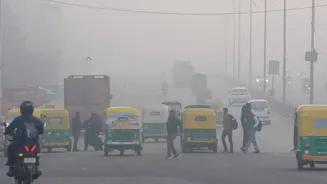

China has laid open its smog playbook to Delhi. Once labelled the world's "smog capital", Beijing is now hailed by environmentalists as an example of how
air pollution can be tackled. And now it is spelling out those lessons for Delhi. In a series of posts on X, Chinese embassy spokesperson Yu Jing wrote how Beijing sharply improved its air quality through sustained interventions over the past decade. "Both China and India know the struggle with air pollution amid rapid urbanisation. While the challenge remains complex, China's sustained efforts over the past decade have delivered noticeable improvements," Jing wrote. The numbers reflect the change. Beijing's annual PM2.5 average stood at 101.7 ug/m3 in 2013. By 2024, it had dropped to 30.9 ug/m3. Jing said the turnaround began with tough action on transport.
'How Did Beijing Tackle Pollution? Step 1'
"How did Beijing tackle air pollution? Step 1: Vehicle emissions control. Adopt ultra-strict regulations like China 6NI (on par with Euro 6). Phase-out retired old, high-emission vehicles. Curb car growth via license-plate lotteries and odd-even/weekday driving rules. Build one of the world's largest metro and bus networks. Accelerate the shift to electric mobility. Work with the Beijing–Tianjin–Hebei region on coordinated emissions cuts. Cleaner air doesn't happen overnight - but it is achievable," she said.
Industry was the second major focus. "Step 2: Industrial Restructuring. Shut down or remove 3000+ heavy industries. Relocating Shougang, one of China's largest steelmakers, alone cut inhalable particles by 20%. Transform vacated factories into parks, commercial zones, cultural and tech hubs. Example, the former Shougang site became the 2022 Winter Olympics venue. Relieve non-capital functions by relocating wholesale markets, logistics hubs and some educational and medical institutions. Coordinate regional integration by shifting general manufacturing to Hebei, while retaining high-value R&D and services in Beijing," Jing said.
Experts in India, however, said that while many of these ideas are well known, it is the execution which has proven to be the weak link.
Anumita Roy Chaudhuri, Executive Director, Research and Advocacy, Centre For Science and Environment, said, "In China, action was not taken just in Beijing but in 26 cities and towns to tackle the problem, which is regional. The first lesson is that the actions they took were urgent, stringent, and at a large scale. They took deep to enable massive energy transition, like getting rid of coal not only in industry but also in household use. Beijing also capped the number of cars that can be sold in a year even as it created infrastructure for public transport. We will find similarities in our plans for Delhi-NCR but the scale is missing."
Saying that Delhi's response is largely reactive, she stated, "We can't have just emergency measures. The implementation of these actions has to be round-the clock."