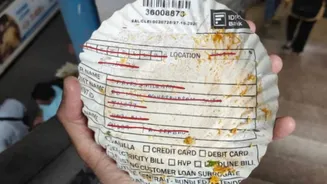

A seemingly ordinary street food moment has turned into a serious conversation about data safety after a viral post exposed what appears to be sensitive
banking information being used as a disposable food plate. The image, now widely circulated on social media, has sparked alarm over how personal data is handled and discarded in India. The photo was shared on X by the account Moronhumor with the caption, “In India, your Data Privacy is not even in your own hands.” It shows a roadside food plate made from what looks like a repurposed bank or financial document, raising serious concerns about the fate of confidential customer records. A closer look at the paper plate reveals printed details such as a person’s name, location, and payment-related information. Although some portions appear to be scribbled out, several fields remain clearly readable, suggesting that sensitive data may still be exposed despite attempts to conceal it. The image appears to have been captured in a busy public transit space, possibly a railway station or a metro staircase, with commuters visible in the background. In the foreground, the individual holding the plate highlights how the document, now stained with food, still visibly carries what seems to be private customer information.
As the post gained traction, social media users reacted with shock, anger, and dark humour, calling out what they described as a blatant breach of data privacy. Many questioned how such documents could enter the recycling chain without proper shredding or disposal.
One user raised concerns over accountability, asking, “Banks should answer how and why papers containing customer details are being sold as recyclable paper to roadside food vendors?”
Another comment, dripping with sarcasm yet underscoring the seriousness of the issue, read, “What if someone uses the EXTREMELY valuable info from this paper plate and steals all of his assets including his savings, house, vehicles and family?”
Several users also speculated about the origin of the document, debating which institution it might have come from and how it was allowed to circulate so freely. The incident has since triggered a wider discussion on lax data disposal practices, weak enforcement of data protection norms, and the potential risks individuals face when sensitive paperwork is mishandled or casually discarded.
The viral image has once again highlighted how everyday negligence can turn into a major privacy concern in an increasingly data-driven world.