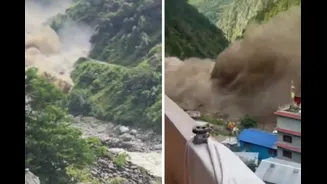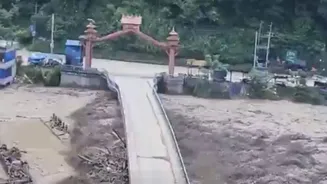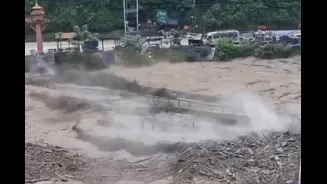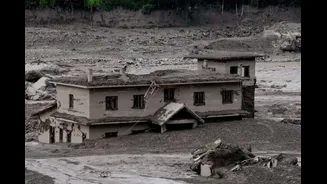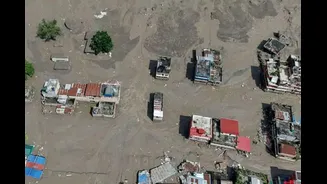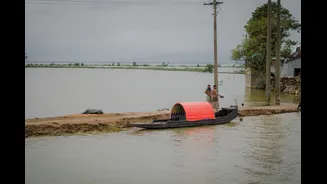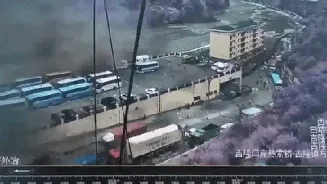




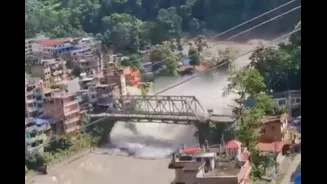
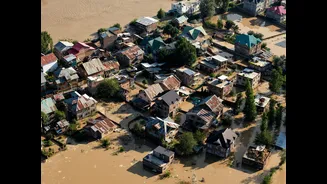
A powerful flash flood that tore through Nepal's Rasuwa district on August 26 has raised fears of another potentially devastating surge. Scientists have
warned that a blockage remains lodged upstream near the Nepal-China border, creating the possibility of a second release of floodwaters. The warning was issued by the International Centre for Integrated Mountain Development (ICIMOD), a Kathmandu-based intergovernmental organisation that studies mountain environments, glaciers, climate change and disaster risks across the Hindu Kush Himalayan region. The latest flood sent a massive torrent of water, sediment and boulders through the Bhote Koshi and Trishuli river systems. Water levels rose dramatically within minutes, while authorities and scientists began assessing what triggered the disaster and whether further danger remains.
Upstream Blockage Raises Fears Of Another Flood
ICIMOD's Head of Climate and Environmental Risks, Qianggong Zhang, said the same area devastated by a previous Rasuwa flood is once again under threat.
An ice avalanche in the Lhende Khola is the suspected trigger, although its cause remains unconfirmed. Zhang said a blockage is still lodged upstream on the Nepal-China border and warned that authorities consider a second flood imminent, with evacuation orders issued for Jilong port.
Scientists are also monitoring downstream areas, including Nuwakot and Dhading, because of the potential for continued impacts.
Preliminary assessments indicate that the latest event damaged infrastructure and hydrological monitoring systems while threatening communities and settlements along river valleys.
The flood reportedly began around 9 AM local time, when water levels in the Bhote Koshi basin rose rapidly before the waters swept downstream into the Trishuli River system.
A key scientific hypothesis is that a large ice-rock avalanche occurred high in the mountains. Hydrological measurements highlight the scale of the event: water levels in the Trishuli River at Galchchi rose by as much as nine metres within 30 minutes, while levels at Malekhu climbed by seven metres over a similar period.
The rapid rise indicates a sudden release of enormous volumes of water and debris from upstream, though scientists are still investigating the precise chain of events.
The disaster has killed at least 157 people, while more than 400 people remain unaccounted for, including hundreds of foreign nationals. Nepal's tourism board said 403 people, including 341 foreign nationals, were reported missing following the floods.