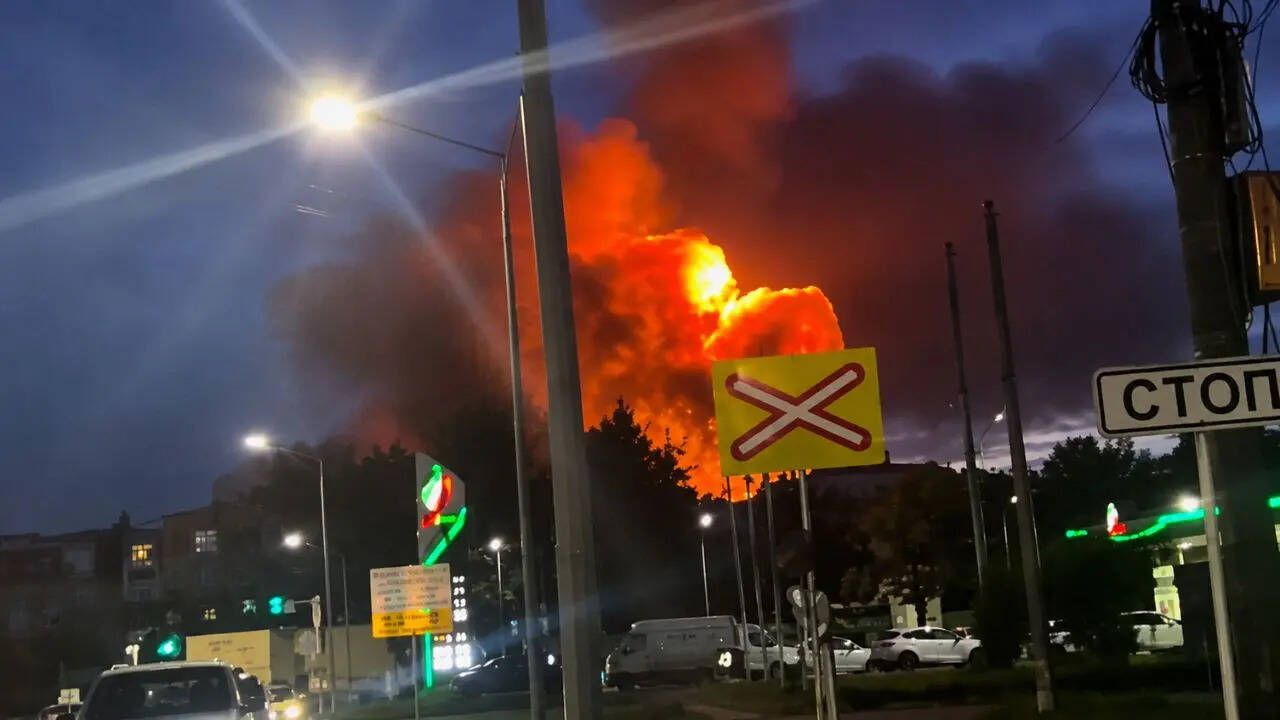








Ukraine has launched what Russian authorities described as a “massive attack” on targets inside Russia, including a major rocket and space facility in Samara
that is involved in the development of satellites. Ukrainian President Volodymyr Zelenskyy said the Progress Rocket Space Centre in Samara, south-western Russia, was among the targets. The facility is the main production centre for Russia's Soyuz-2 rockets and also develops Earth-observation and military spacecraft. Videos shared on social media appeared to show the TsSKB-Progress complex in Samara on fire, with thick plumes of smoke rising above the site. Zelenskyy said the strike was intended to reduce Russia's ability to wage war against Ukraine. “It is important that Russia's war potential be reduced. Peace is needed, and this must be evident in Russia – through concrete damage to specific facilities,” he said in a post on X.
Moment de l'explosion sur l'usine russe "Progress" à Samara, suite à l'impact du drone FP-5 "Flamingo".https://t.co/kMQPd33BHN pic.twitter.com/HJi940Pzv6
— 𝑬𝒗𝒆𝒍𝒚𝒏𝒆 𝑳 🇫🇷 🇺🇦 🇪🇺 (@TKouilou) August 15, 2026
Ukrainian forces reportedly used FP-5 Flamingo cruise missiles in the attack. Kyiv has shared footage purporting to show two Flamingo launches targeting Samara.
The missile is a Ukrainian-made cruise weapon reported to have a range of up to 1,860 miles and a one-tonne warhead.
The potential targeting of the Progress facility is significant because Russia is developing its own satellite communications network, known as Rassvet, which is intended to provide secure internet connectivity for military operations.
Rassvet has been described as Russia's answer to Elon Musk's Starlink satellite network, which has played an important role in Ukraine's communications and drone operations during the war.
🇺🇦🚀 Ukraine struck two strategically important Russian targets overnight: the Progress Rocket Space Centre in Samara and Savasleyka military airbase in Nizhny Novgorod region.
— GMan | GMan’s Chronicle (@FAB87F) August 15, 2026
Ukraine says domestically produced Flamingo cruise missiles struck the Progress aerospace complex in… pic.twitter.com/jNqf2RVoXW
Russia has sought to accelerate development of its own system after Russian forces were barred from using Starlink.
Ivan Noskov, head of the Samara regional capital, said Russian air defences had repelled a “massive attack”. “Samara's industrial infrastructure sustained localised damage,” he said in an online post, without identifying the facility involved.
Noskov said there had been casualties and that he was working with the management of the enterprise and emergency services at the scene.
Ukraine has increasingly used domestically produced long-range weapons to strike military and industrial targets deep inside Russia.
Ukraine also targeted the Savasleyka military airfield in Russia's Nizhny Novgorod region, Zelenskyy said. The airfield, east of Moscow, is home to Russian MiG-31K aircraft, which can carry Kinzhal hypersonic missiles used in attacks against Ukraine.
Large explosions were reported at the airbase overnight.
Ukraine also said it had targeted Russian Iskander missile launch sites near Balaklava in occupied Crimea, where fires were reported.
The attacks came as Ukraine seeks to put pressure on Moscow to agree to a peace settlement.
Meanwhile, Russian forces carried out further strikes in Ukraine, with a three-month-old boy killed in the city of Marhanets in the Dnipropetrovsk region, according to Ukrainian officials. The strike hit a four-storey residential building, with about a dozen people reportedly injured.
Two children – a five-year-old boy and a 12-year-old girl – were among those hurt.
The attacks came as Ukrainian forces appeared to have pushed Russian organised military units out of almost all of the Dnipropetrovsk region following a seven-month counteroffensive.
A Russian military channel acknowledged what it described as a “temporary withdrawal”, although Kyiv has not formally declared the region completely cleared.
The latest developments come amid continued fighting along the front line, as both sides use increasingly long-range weapons to target military infrastructure far from the battlefield.