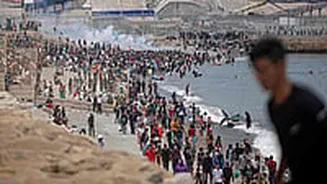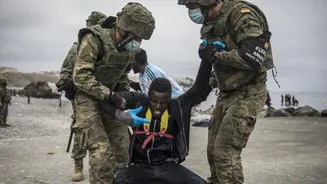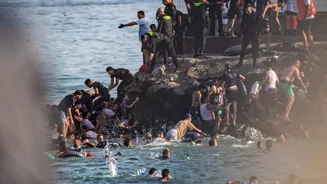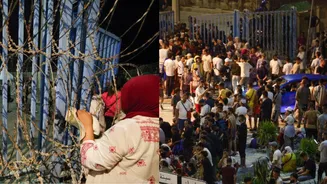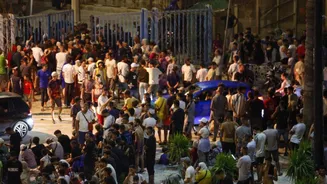









Spain said Friday that the massive migrant surge into its North African enclave of Ceuta is beginning to reverse, with tens of thousands of people returning
to Morocco after one of the largest border crossings ever witnessed at the European Union's only land frontier with Africa. Authorities said more than 50,000 people crossed into Ceuta by land and sea since Thursday, although local officials estimated the figure may have reached 60,000. The Spanish government said around 48,300 migrants had voluntarily returned or been repatriated by Friday evening, while efforts to clear the remaining arrivals were continuing. The crisis turned deadly, with Spanish authorities confirming that 57 bodies had been recovered on the Spanish side of the border. Officials warned the toll could rise further, saying additional casualties were feared on the Moroccan side. Some migrants reportedly drowned while attempting to swim around the border, while others were crushed trying to scale the breakwater separating Morocco from the Spanish territory. The unprecedented influx overwhelmed Ceuta, a city of around 85,000 residents, as thousands of migrants flooded streets, public spaces and temporary shelters, stretching local security forces and emergency services. Spanish Prime Minister Pedro Sánchez, who travelled to Ceuta on Friday, described the mass crossing as "a violation of Spain's territorial sovereignty" and said the government was working with Morocco to accelerate the repatriation of migrants who entered illegally. Sánchez also announced additional border security measures, including the installation of floating barriers, and said Spain was considering legal changes to speed up future deportations following large-scale illegal crossings. On the Moroccan side, riot police used tear gas, batons and water cannons to disperse crowds attempting to reach the enclave, while Spanish military vehicles patrolled the border fence. Many migrants who returned cited the lack of food, shelter and basic facilities inside Ceuta. "Honestly, I don't even know why I came, and now I'm going back," one young Moroccan migrant told Reuters, saying he had gone without food since arriving. The crisis has also triggered political tensions across Europe. Italy announced it was temporarily suspending Schengen travel arrangements with Spain, arguing the situation required tighter border controls, a move Madrid said violated EU rules. The border rush has reignited debate over Spain's migration policies. Conservative leaders across Europe accused Madrid's recent migrant amnesty measures of encouraging illegal crossings, while the Spanish government rejected the criticism. U.S. President Donald Trump also weighed in, describing the incident as looking "like an invasion" and blaming Spain's migration approach. Ceuta, along with the nearby Spanish enclave of Melilla, represents the European Union's only land border with Africa and has long been a flashpoint for migration. However, officials said the scale of this week's crossings was unlike anything previously recorded.