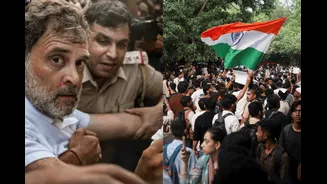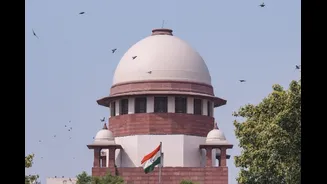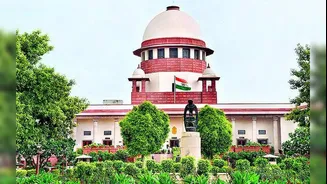





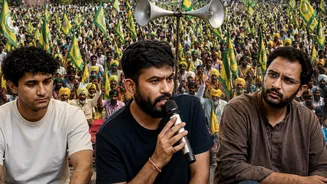
New Delhi: The Supreme Court on Monday questioned the Delhi Police for alleged crackdowns during the Cockroach Janata Party's (CJP's) "Sansad Chalo" protest
march. Hearing a plea concerning the alleged violence during the July 20 protest at Delhi's Jantar Mantar, the Supreme Court bench headed by Chief Justice of India (CJI) Surya Kant remarked that "agitation does not mean lathicharge." The bench also questioned protesters over the incidents of violence. "Agitation does not mean violence," the bench further remarked, stressing that both protesters and authorities must exercise restraint. The bench also insisted on the need to formulate uniform pan-India guidelines for handling protests. It also directed that the matter should be approached cooperatively rather than as an adversarial dispute between the petitioners and the governments. The Supreme Court also noted that every citizen has the right to citizen's right to protest peacefully is constitutionally guaranteed and must be protected. However, the bench said excesses from police and protesters both have to be looked into dispassionately. The CJI also questioned authorities for not giving adequate protective gears to the police. CJI Surya Kant pointed out that if there is a protest in case anti-social elements barge in, then authorities has to deal with it. Meanwhile Solicitor General Tushar Mehta urged to the bench to club all the petition relating to the matter and schedule the next hearing on Tuesday. After a series of remarks, the top court adjourned the hearing to tomorrow. The plea was filed by lawyer Shailendra Mani Tripathi. Senior Advocate Gopal Sankaranarayanan appeared for Tripathi in the court. The pea sought an appointment of an independent, high-powered Judicial Commission or a Special Investigation Team (SIT) headed by a retired Judge of the Supreme Court to investigate the physical excesses, arbitrary detentions committed by the Delhi Police during the July 20 protest march. It also sought immediate register of an FIR against "delinquent" police personnel.
Other key Prayers Mention In The Plea :
- Direction to Union and all states/UTs to frame and strictly implement comprehensive national guidelines ensuring that no police officer on official duty can be in plain clothes or without visible nameplates/identity badges and to declare any use of coercive force by unidentifiable or plainclothes personnel during public assemblies as arbitrary, illegal and a major service misconduct.
- There be no repetitive, or blanket prohibitory orders in any area without an objectively verified, proximate, and recorded threat of grave public disorder.
- No person shall be prosecuted under this section for political dissent, academic critique, peaceful protest, or criticism of the government unless there is a direct, proximate, and imminent incitement to armed rebellion or secessionist violence
- Direct the immediate, time-bound, and literal implementation of the police reform directives laid down in Prakash Singh v. Union of India (2006), specifically the establishment of fully functional, independent, and structurally empowered State and District Police Complaints Authorities (PCAs) whose recommendations for disciplinary and criminal action against delinquent officers shall be binding.