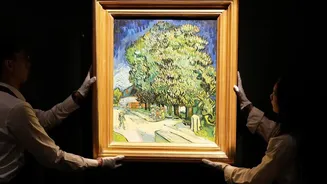









Vincent van Gogh’s Châtaigniers en fleurs (“Chestnut Trees in Blossom”) has sold for $190.4 million at auction in New York, a new record for the artist.
The previous high was $117.2 million, paid at Christie’s in November 2022. The Dutch artist painted the work in 1890 in Auvers-sur-Oise, a commune north of Paris. He arrived there on May 20, 1890, after spending about two years in the south of France. According to Sotheby’s, the painting was “painted on or just before May 24 and stands out for its spectacular colouring and expressive execution.” The auction house describes the composition as showing “a cluster of large chestnut trees located on what is today the Avenue Charles de Gaulle in Auvers in the center of the village.” The canvas has travelled widely since. It passed from Vincent to his brother Theo van Gogh in Paris, then by descent to Theo’s widow, Johanna van Gogh-Bonger, and her son Vincent Willem van Gogh in Amsterdam. The dealer Paul Cassirer in Berlin acquired it in September 1905, and by March 1906 it belonged to Alexandre Berthier, Prince de Wagram. It then moved through Galerie Druet to the collector Gustave Fayet in January 1909. That same year, via Galerie Bernheim-Jeune, it was bought by Samuel Fischer, a German Jewish publisher based in Berlin Grunewald. His widow, Hedwig Fischer, inherited it in 1934. In 1936, the painting was acquired by Henriette and Marcel Kapferer of Paris through Paul Cassirer in Amsterdam, where it had been on deposit since 1932/33 by Gottfried Bermann Fischer. From 1939 it was on deposit with Wildenstein & Co. in New York, and was later consigned to the gallery. George “Buddy” Gard DeSylva and Marie DeSylva (née Wallace) of Los Angeles bought it in 1945 and held it until at least 1950. By 1953 it belonged to Harriet Harris-Jonas of New York, whose estate consigned it to Wildenstein in 1974. The present owners acquired it from the gallery in 1975. Read More:Jaipur Turns 300 In 2027: The Maharaja, The Auditor And The City Built In Four Years However the sale of the painting was surrounded with controversy. The heirs of Samuel Fischer, who now live in the US, asked Sotheby’s to withdraw the painting. They argued that the family parted with it under duress in Amsterdam because of Nazi persecution. According to reports, their lawyers wrote to the auction house. The heirs said the painting had to be sold before the Second World War because the family’s publishing company had suffered losses. The two sides later reached an agreement. In a statement, Sotheby’s said: “In recognition of the painting’s complex Nazi-era history and the suffering endured by the Fischer family during the Holocaust, the two families have reached a mutually satisfactory resolution and the work will be sold pursuant to their agreement.”