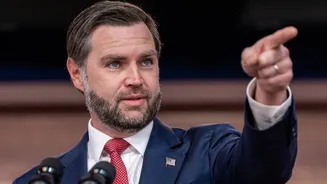

US Vice-President JD Vance on Thursday warned American companies against laying off domestic workers and then using H-1B visas to hire foreign employees
at lower wages. "We're not going to let you lay off American workers so you can replace them with cheap foreign labor," Vance said in a message linked to a White House fact sheet outlining the Trump administration's actions on H-1B visas. The Department of Labor's inspector general, Anthony D'Esposito, echoed the warning, writing: "Lay off Americans to hire cheaper foreign labor? Expect us to come knocking." The administration has said companies that sponsor H-1B petitions will face scrutiny over their employment practices, particularly where they have dismissed US workers and subsequently hired H-1B visa holders for similar roles. The issue is part of a wider effort by the Trump administration to change how the H-1B programme is used. The administration says the visa should prioritise highly skilled workers rather than being used to replace American employees.
What Is The Administration Changing?
The administration has previously introduced a $100,000 fee requirement for some new H-1B applications. The measure faced a legal challenge and was struck down by a court, but the administration has renewed the requirement.
The Department of Homeland Security has also proposed a separate H-1B fee of $103,265. That proposal has not yet been implemented.
The administration has also moved to replace the traditional random H-1B lottery with a wage-based selection system.
According to White House figures, unemployment among recent computer science graduates had reached 6.1% and 7.5% among computer engineering graduates before the 2025 H-1B fee proclamation. The White House said those rates were more than twice those recorded among biology and art history graduates.
It also said H-1B registrations from the largest IT outsourcing companies had fallen by 92% since the proclamation took effect.
The administration further claims that consular processing requests have fallen by nearly 97% and that the changes have shifted H-1B hiring away from lower-paid foreign workers towards higher-skilled and higher-paid workers.
What Vance Said About H-1B Visas
Vance discussed the administration's approach to H-1B visas during an appearance on the All-In Podcast.
He said the administration had pursued administrative changes because of what he described as political gridlock in Congress. "Look, man, we looked at the fraud in the system and we said, you know, one, Congress is not going to pass a law changing this. There just isn't the political will to do it. So what are the things that we can do administratively to ensure that if a tech company is going to try to get an H-1B visa, it's an actual genius."
He said the administration wanted H-1B workers to make a significant contribution to the US technology sector or wider economy. "It's a person that is going to significantly enrich the tech ecosystem or the American economy. You know, you're not just replacing one accountant who makes $60,000 with a lower-wage foreign accountant who makes $45,000 a year. That is not what the programme exists for."
Vance also defended the $100,000 fee and other measures aimed at preventing companies from using H-1B workers after laying off American employees. "And so we came up with this idea to impose a $100,000 fee. We're also looking at various ways of preventing companies that use H-1B visas from laying off a bunch of American workers."
He questioned the hiring practices of companies that claim they cannot find workers while also carrying out large-scale layoffs. "We can't find the workers. And then you go and look at their history and they've laid off 5,000 people. Well, that's ridiculous."
Vance said the administration was working within its legal authority despite facing lawsuits over some of its measures. "If you're laying off American workers, you shouldn't be going to the market searching for foreign workers to replace them. So we're doing a lot within the confines, of course, of what we're allowed to do legally. We've gotten sued on some of this stuff, but I think fundamentally we're on the right on both the law and the policy."
He concluded by describing the administration's intended role for the H-1B programme: "The H-1B should not exist to replace American workers with low-wage foreigners. It should exist to enrich the American economy. And that's exactly what we're trying to make sure it does."