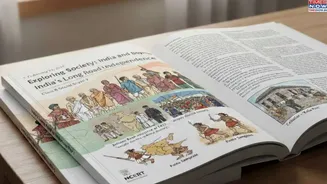







In line with the National Education Policy (NEP), the National Council of Educational Research and Training (NCERT) released a new Class 8 Social Science
textbook on February 23, 2026. The latest version has re-added, elaborated on, or given a new perspective on the incidents that happened in the past. According to the new version, although freedom fighter Mahatma Gandhi and other Congress leaders denounced the idea of Partition in 1947, and even Indian Muslims protested it, leaders were left with no choice but to accept it later. The older version of Class 8 history books asserted that a three-member mission sent by the British Cabinet to Delhi for recommending a governance structure for a free India “could not get the Congress and the Muslim League to agree to specific details of the proposal” and “Partition now became more or less inevitable”. It did not mention it as the only way forward for Congress leaders. The chapter titled ‘India’s Long Road to Independence’ in the new book — Exploring Society: India and Beyond Part 2 — covers all crucial events post the 1857 revolt to 1947, shedding light on the freedom movement, the Partition of Bengal, and the Partition of India. Part 1 of the Social Science book for Class 8 was distributed in July last year. The textbook elaborates that historians put multiple reasons forward for Britain's exit from India and that the “earlier opinion displayed gratitude towards Gandhi, his principle of non-violence, and the Congress policies,” adding, “This view has given way to a recognition that multiple other factors were also at work – the popular uprisings, the numerous attempts by revolutionaries, the mutinies in the Royal Indian Air Force and the Royal Indian Navy.” “Also, Britain’s diminished status after World War II, and the worldwide trend towards decolonization – the age of empires was over, at least in that form,” it says. NCERT has been revamping textbooks in accordance with the National Education Policy 2020 and the National Curriculum Framework for School Education 2023. Till now, substantial revisions have been noted in Classes 1 to 8 textbooks, some of which, especially those related to history, have even sparked controversies among historians, lecturers, and politicians due to selective inclusion or exclusion of events. On the brutal Jallianwala Bagh massacre of 1919, it states that, to date, the British government has not apologised for the merciless killings of Sikhs who gathered there for the Baisakhi festival and a peaceful protest meeting. The book marks the event as 'deeply shameful in British history', which was missing from the older version. About the 'Direct Action Day', a huge political strike organised by the All-India Muslim League on 16 August 1946, the book states, “A wave of brutal communal violence submerged Calcutta – often encouraged by provocative speeches and pamphlets – leading to thousands of deaths as Muslim mobs attacked Hindus, who then retaliated. Thousands more were displaced. The violence created a deep sense of fear, making peaceful coexistence seemingly impossible and Partition unavoidable." The new version is quite specific and detailed when compared to the older one, which said, “riots broke out in Calcutta, lasting several days and resulting in the death of thousands of people”. Moreover, the book has added a new section on the 'Paika Sangram', the first armed rebellion against Company rule in 1817. When the first part of the book was issued in July 2025, many, including the former Odisha Chief Minister Naveen Patnaik, protested against the removal of the Paika rebellion from the textbook as a “huge dishonour” to the Paikas. Therefore, the authorities decided to include it. The book also emphasises the treatment that the rebels faced at the Cellular Jail, also known as “Kala Pani", a colonial prison. “The Cellular Jail in the Andaman Islands was a huge colonial prison used by the British to exile and isolate revolutionaries, far from the mainland. Known as ‘Kala Pani’ (‘Black Water’), it was designed specifically for solitary confinement and used to break the spirit of freedom fighters. Prisoners faced horrific conditions, including extreme physical labour, such as extracting oil by hand, and brutal punishment for the slightest disobedience,” said the book. “A few revolutionaries who were imprisoned there, such as Barindra Ghose or V.D. Savarkar, left vivid descriptions of forced labour and ill-treatment of the prisoners. Many of them died and some lost their sanity. Those who tried to escape were hanged. The jail became a symbol of ultimate sacrifice in India’s struggle for freedom,” it added. Recommended | What’s New in NCERT Textbooks? A Look at Five Major Changes Introduced in 2025