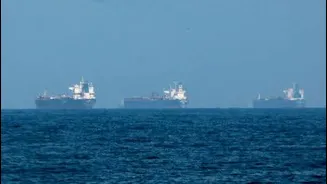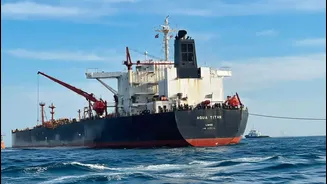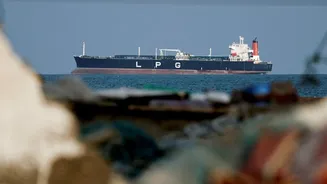







Amid rising concerns over a potential crude supply disruption due to the Middle East crisis, India’s oil buffer can sustain the country for about 9.5 days
using strategic reserves, according to the government. Minister of State for Petroleum and Natural Gas Suresh Gopi said in Parliament that India’s strategic petroleum reserves are designed to provide short-term relief during supply shocks or extreme price volatility. Data from Indian Strategic Petroleum Reserve Ltd shows that the country currently holds around 3.37 million tonnes of crude oil—about 64% of its total 5.33 million tonnes storage capacity. India, the world’s third-largest energy consumer, remains heavily dependent on imports, sourcing nearly 88% of its crude requirements from overseas. A significant portion of these supplies flows through the critical Strait of Hormuz, making the country particularly vulnerable to geopolitical disruptions. To cushion against such risks, India has developed underground storage facilities at Visakhapatnam, Mangaluru, and Padur, which act as emergency buffers. However, the minister noted that reserve levels are dynamic and depend on both consumption patterns and stock availability. Beyond strategic reserves, India’s total crude and petroleum storage—including stocks held by oil marketing companies—can cover about 74 days of consumption, offering a broader safety net. The government has also been actively diversifying supply sources, expanding imports to 41 countries, including the United States, Nigeria, Angola, Canada, Brazil, and Mexico, to reduce reliance on the Gulf region. Looking ahead, additional storage capacity of 6.5 million tonnes is being developed at Chandikhol in Odisha and Padur in Karnataka, aimed at strengthening long-term energy security. The update comes at a time when the ongoing conflict involving Iran is disrupting global oil and gas flows, raising the stakes for energy-importing nations like India.