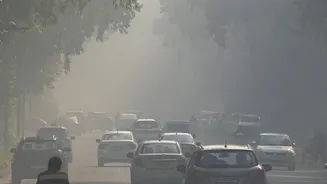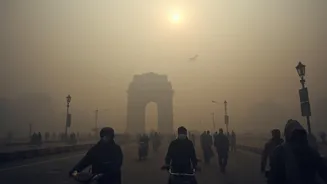

Delhi’s air quality plunged to severe levels on Sunday, with the 4 pm Air Quality Index (AQI) reading hitting 440, the highest for the month in the past
two years. This tied with the joint-worst reading for the second half of January, matching Jan 17, 2019. The capital’s last severe air day was Dec 29, 2025, when the AQI was 401. Experts attributed the spike to calm winds, dense fog, and stagnation of local emissions, along with high pollutant contributions from neighboring districts such as Gautam Budh Nagar, Ghaziabad, and Bulandshahr. The AQI is expected to improve slightly to ‘very poor’ on Monday and remain within the same range on Tuesday, though long-term improvement requires systematic emission reductions. As per AQI classification, a reading between 0 and 50 is 'good', 51 to 100 'satisfactory', 101 to 200 'moderate', 201 to 300 'poor', 301 to 400 'very poor' and 401 to 500 'severe'.
Stage-IV GRAP In Action
In view of the worsening air quality, the Commission for Air Quality Management (CAQM) on Saturday reinstated Stage-IV measures under the Graded Response Action Plan (GRAP) across Delhi and the National Capital Region (NCR).
Also Read | Delhi-NCR Air Emergency: GRAP-4 Enforced In Delhi-NCR as AQI Crosses 400 - What It Means for You
"Keeping in view the prevailing trend of air quality and relevant factors and in an effort to prevent further deterioration of air quality in the region, the CAQM Sub-Committee on GRAP unanimously decides to invoke all actions as envisaged under Stage-IV of the extant GRAP - 'Severe+' Air Quality (DELHI AQI > 450), with immediate effect, in the entire NCR, as a proactive measure. This is in addition to the actions under Stages I, II & III of the extant GRAP already in force in NCR," the CAQM order stated.
The directive further noted, "NCR Pollution Control Boards and other agencies concerned have been asked to escalate the preventive measures to prevent further deterioration of air quality in the region."
Dense Fog and Flight Disruptions
Dense fog shrouded the city on Sunday, with visibility dropping to zero at Safdarjung and 100 meters at Palam early in the morning, according to the India Meteorological Department. A yellow alert for moderate to dense fog was issued for Monday morning.
The poor visibility caused significant flight delays at Indira Gandhi International Airport, though no cancellations or diversions were reported. Data from FlightRadar24 showed over 500 flights delayed, with an average delay of around 34 minutes.
Temperatures remained low with a minimum of 5.3°C and a maximum of 22.7°C, while forecasts suggest a slight rise in minimum temperatures to 9°C–11°C by Jan 23. Very light rain is possible under the influence of a fresh western disturbance.