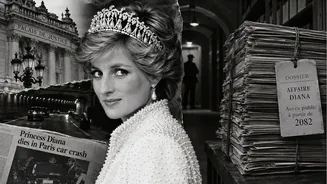









The Epstein files have dominated this year's conversation about official secrecy, but they are hardly the only government dossier the public is not allowed
to see. In a basement of the Palais de Justice in Paris sits a nearly one-meter-tall stack of paper - some 6,000 pages compiled by French police after the 1997 crash that killed Diana, Princess of Wales, her partner Dodi Al Fayed and their driver, Henri Paul. It will not be opened to the public until 2082, and possibly never. An 18-month Inquiry, Then A Lock And Key The dossier is the product of an 18-month French judicial investigation into the crash in the Pont de l'Alma tunnel. Investigating magistrate Herve Stephan closed the case with a one-page ruling that attributed the crash to alcohol, drugs and excessive speed, clearing the nine photographers and the motorcyclist who had been chasing the car of criminal responsibility. Toxicology work overseen by Professor Ivan Ricordel put the driver's blood alcohol at more than three times France's legal limit, with traces of prescription medication in his system as well. A British inquest reached a broadly similar, if legally distinct, conclusion in 2008, returning a verdict of unlawful killing through grossly negligent driving by Paul and the pursuing paparazzi. None of that, however, is what is locked away. The sealed material - which includes the witness statements, toxicology data, crash-scene photography - falls under article L213-2 of France's heritage code, which withholds certain national archival files from public access for 75 years from the date a case closes. Because the investigation was formally completed in 2007, the earliest release date is 2082. A Palais de Justice spokesperson, pressed on the matter, confirmed the file sits in the archives of the Paris Court of Appeal and cannot legally be consulted before that window closes, and that no digitized version exists. Even confirming the archive existed took months of inquiry, and the documents are reportedly kept under armed guard. French authorities can also extend the seal indefinitely once the 75 years lapse. What The File Is Rumored To Hold? What sits inside those 6,000 pages has never been described in detail. French investigators have said their own lingering frustration was a white Fiat Uno that grazed the Mercedes moments before the crash and was never traced. Martine Monteil, who led the Brigade Criminelle's inquiry, told a Channel 4 documentary that the untraced car remains an open thread even though she considers the driver blameless for what followed. Mohamed Al Fayed, Dodi's father, spent years arguing publicly that MI6 or elements of the royal family had a hand in the deaths, at points asserting that Diana was pregnant and that Henri Paul was a British intelligence asset. However, a Scotland Yard review, Operation Paget, examined 175 such claims and rejected all of them. A former MI6 officer, Richard Tomlinson, separately told French investigators under oath in 1999 that he believed the agency had monitored Diana and that Paul may have had intelligence ties - an allegation investigators also found no evidence for. Also Read: National Engineers' Day: Why India Marks It On Sir M. Visvesvaraya's Birthday Other theories, circulated by state media in Iraq and Libya at the time, alleged an outright assassination by Western intelligence services, while more fringe claims have tied her death to arms-control politics or dismissed the whole event as staged. A File Built For Speculation None of this amounts to evidence of foul play, and two governments, a decade apart, reached the same forensic conclusion. But a sealed file is not a smoking gun, it is a blank page, and blank pages invite projection, especially onto a death as psychically unresolved as Diana's. As her 30th anniversary approaches in 2027, and with the Epstein files reviving public appetite for transparency generally, the Palais de Justice's basement archive serves as a reminder that some of the century's most consuming mysteries are, in the end, a matter of what governments choose - deliberately, sometimes almost incidentally - not to show us.