






What is the story about?
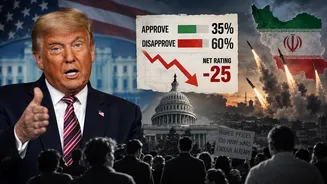
US President Donald Trump’s net approval rating doesn't seem to be doing too well with the latest figures falling to -25, with 35% of Americans approving
of the job he is doing and 60% disapproving, according to the latest YouGov tracker. The figures place Trump’s overall approval firmly below his disapproval rating as Americans continue to rank economic concerns, particularly inflation and prices, among the most important issues facing the country. The tracker also shows substantial differences between demographic groups. Trump’s net approval is around -18 among men and -31 among women, while the figure ranges from about -15 among voters aged 65 and above to -39 among those aged 30 to 44.
Trump Approval Rating Shows Wide Demographic Gaps
The racial divide is more pronounced in the YouGov figures. The tracker puts Trump’s net approval at around -15 among White voters, -32 among Hispanic voters, -43 among voters categorised as “Other” and -61 among Black voters.
Education also produces a notable gap. Trump’s net approval is around -15 among people with a high-school education or less, compared with approximately -25 among those with some college education, -31 among college graduates and -32 among postgraduates.
The latest figures follow months in which Trump’s approval has remained around the high-30s in the average cited in the input. Individual high-quality polls have recently placed his approval lower, with the figures ranging from around 30% to 40%, underscoring the variation between individual surveys and polling averages.
The Iran War has also featured prominently in recent polling on Trump's presidency and foreign policy. In a Quinnipiac University national poll released in July, 34% of registered voters said they supported US military action against Iran, while 60% opposed it. The poll described the 60% opposition figure as the highest recorded since Quinnipiac began asking the question after the conflict started.
Iran War Opposition And Economic Concerns
Earlier Quinnipiac polling also showed that views of Trump's handling of Iran were negative. In April, 36% of registered voters approved of the way Trump was handling the situation with Iran, while 58% disapproved. At the time, 40% supported US military action against Iran and 53% opposed it.
By June, Quinnipiac found that 60% of voters believed US military action against Iran was not worth it, compared with 34% who said it was worth it. The same poll showed significant partisan differences, with 75% of Republicans saying the action was worth it, while 93% of Democrats and 66% of independents said it was not.
The latest YouGov tracker also points to the domestic issues competing with foreign policy for voters' attention. Inflation and prices are identified as the biggest concern, with 33% naming them as the most important issue facing America.
Jobs and the economy follow at 13%, while healthcare is cited by 11%. The longer-term trend in the data shows economic issues becoming increasingly prominent, while immigration, healthcare, civil rights and national security remain lower on the list of Americans' most important concerns.
The polling therefore captures several distinct measures rather than a single verdict on the Iran War. Trump's overall approval is at 35% in the latest YouGov tracker, while separate polling has measured voter attitudes towards the military action itself, and the YouGov data show that economic concerns remain central to how Americans assess the country's direction.