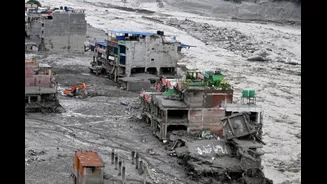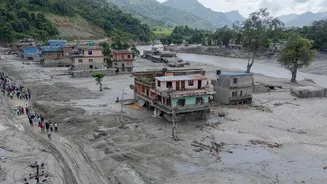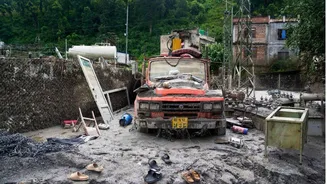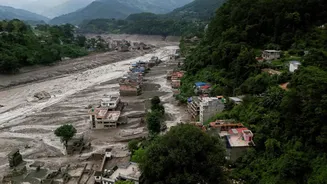







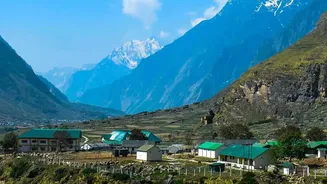
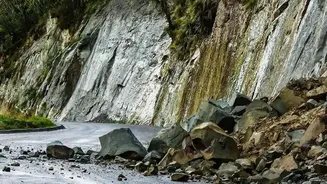
Nepal has called for climate compensation after last week’s devastating flash floods killed more than 1,000 people and left thousands missing. Foreign
Affairs Minister Shisir Khanal said China, the United States and India, which he identified as the world’s top industrial emitters of carbon dioxide, have a “historical responsibility to compensate” countries such as Nepal that are highly vulnerable to climate change, The Kathmandu Post reported. The August 26 flash floods struck Nepal’s Rasuwa district along the border with China. According to the latest figures cited in reports, 1,003 people have died, including 987 in Nepal and 16 on the Chinese side. Nearly 4,500 people are still missing, AFP reported. The United States Geological Survey said the floods were triggered by a glacial collapse that sent a huge volume of water and debris downstream. There was reportedly no rainfall in the area at the time, leaving residents with little or no warning. In an interview with Kantipur TV, Khanal described the disaster as a “catastrophic mountain tsunami” and linked it to the wider effects of global climate change, according to The Kathmandu Post. “Nepal’s greenhouse gas emissions are virtually negligible,” the minister was quoted as saying. “Yet, we are paying the ultimate price for a global crisis we did not create.” Nepal accounts for only around 0.04% of global emissions.
Nepal Wants ‘Justice And Compensation’, Not Charity
Khanal said Nepal was changing its approach to climate diplomacy, moving from seeking traditional aid towards demanding “justice and compensation”.
“This is not a matter of charity; it is a matter of legal and moral liability,” he said.
The minister said Nepal had already sent a climate compensation claim to its international partners, although he did not name the countries involved.
“We will be raising this issue with absolute firmness and clarity at every upcoming international forum,” he was quoted as saying by the local news outlet. “This is a matter of civilisational survival.”
Khanal also said India, China and the United States have a “historical responsibility to compensate vulnerable nations like Nepal”.
What The Emissions Data Shows
According to the European Commission’s Emissions Database for Global Atmospheric Research 2025 report, China, the United States and India were among the largest greenhouse gas emitters in 2024, along with the EU27, Russia and Indonesia.
The report said these six groups accounted for 61.8% of global greenhouse gas emissions in 2024.
While emissions from the European Union have declined, the report noted significant increases in countries including China and India over the longer term.
India, however, has consistently argued for climate equity, pointing to its relatively low per-capita emissions. New Delhi has maintained that climate responsibilities should take into account countries’ historical emissions, development needs and capacity.
India has also argued that developed countries, which industrialised earlier, have used a larger share of the global carbon budget and should provide financial support to developing countries dealing with climate-related impacts.
Why Nepal Is Particularly Vulnerable
Experts say Nepal and other Himalayan countries face growing risks from glacier melt, landslides, floods and other climate-related hazards despite contributing relatively little to global emissions.
Saswata Sanyal, a disaster risk resilience expert at the International Centre for Integrated Mountain Development in Kathmandu, said Nepal has suffered from the much larger emissions of wealthier countries and called for better disaster planning and early warning systems.
Manjeet Dhakal, a Nepali climate policy expert and United Nations climate negotiator, said Nepal has emitted less than 0.1% of the greenhouse gases responsible for global warming while facing some of its most severe consequences.
“We should blame those who are responsible for increasing the global temperature, those who have benefited from the fossil fuel economy for such a long time,” Dhakal said, according to the Associated Press. “We can at least use this devastating example as an inspiration to urgently reduce carbon emissions.”