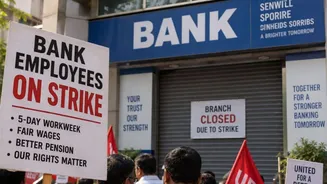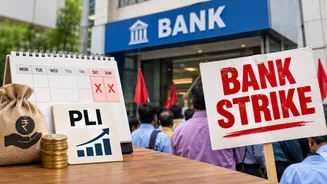








Banking operations across India are likely to face disruption on Friday, September 11, as bank employee and officer unions stage a nationwide strike over
two key issues: the long-pending demand for a five-day banking week and changes proposed to the Performance Linked Incentive (PLI) system. The protest has been called under the banner of the United Forum of Bank Unions (UFBU), which represents several major employee and officer unions in the banking sector. The unions have lined up multiple rounds of industrial action, with another three-day strike planned later this month. If negotiations fail to resolve the issues, bank unions have also warned of an indefinite strike beginning October 26, potentially leading to prolonged disruption of branch-level banking services. The immediate trigger for the latest strike is the unions’ demand for implementation of a five-day working week across banks. The proposal dates back to the 12th Bipartite Settlement and 9th Joint Note, signed in March 2024. Under the agreement, the Indian Banks’ Association (IBA) had agreed to the introduction of a five-day banking system, with working hours from Monday to Friday adjusted to compensate for Saturdays becoming holidays. In practical terms, the proposed arrangement would mean bank branches operating during weekdays while remaining shut on both Saturdays and Sundays. According to the UFBU, the proposal has remained pending before the government for more than two years, despite the IBA having recommended it. PLI Row: Why Are Bank Unions Opposing The New Formula? The second major point of contention is the revised Performance Linked Incentive scheme. The unions have argued that their understanding with the IBA was that PLI should be determined by the overall performance of the bank. They also maintain that a common framework was envisaged for employees and officers up to Scale VII. The UFBU has raised objections to a revised structure that would allow officers in Scale IV and above to receive PLI equivalent to as much as 365 days of basic pay, depending on individual performance. By comparison, workmen employees and officers up to Scale III would reportedly have a maximum entitlement of 15 days of basic pay plus dearness allowance. The unions have termed the proposed arrangement discriminatory. They want the revised PLI framework withdrawn and the matter taken up again through bilateral negotiations. Will Banks Be Closed On September 11? Customers visiting physical bank branches on September 11 could encounter disruptions because of the nationwide strike called by participating unions. However, the strike is not expected to completely halt all banking channels. Customers may continue to use internet banking, mobile banking, ATMs and other automated services, although the availability of particular services could differ from one bank to another. Those planning branch visits may therefore want to complete important transactions in advance or rely on digital channels where possible. More Bank Strikes Planned This Month The September 11 action is only the first in a broader strike programme announced by the UFBU. Bank unions have scheduled another three-day nationwide strike from September 28 to September 30. The unions have further warned that the agitation could escalate into an indefinite strike from October 26 if their demands remain unresolved. For customers, the outcome of the negotiations could therefore determine whether banking disruptions remain limited to individual strike dates or extend into a longer period.