
= India and the European Union are set to announce a landmark free trade agreement (FTA) today—described by European Commission President Ursula von der
Leyen as the “mother of all deals.” The long-anticipated pact is expected to mark a historic turning point in India–EU relations, significantly expanding cooperation across trade, defence, technology, climate action and people-to-people ties. Here are 10 key takeaways from the breakthrough agreement:
- A transformative partnership
The India–EU FTA is expected to bring a qualitative shift in bilateral ties, strengthening cooperation across multiple strategic sectors including trade, defence, climate change, critical technologies and the rules-based global order. - Beyond trade: defence and security cooperation
Alongside the FTA, India and the EU are set to unveil a Security and Defence Partnership (SDP) and a broader strategic agenda, reflecting growing convergence on geopolitical and security challenges. - Europe’s strategic recalibration
The deal comes as the EU seeks to reduce its economic and strategic dependence on both the US and China, while deepening partnerships with emerging global players such as India. - High-level summit in New Delhi
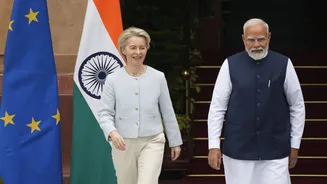
Prime Minister Narendra Modi is hosting European Commission President Ursula von der Leyen and European Council President Antonio Costa at the summit. Both leaders were chief guests at India’s 77th Republic Day celebrations at Kartavya Path. - A massive economic bloc
Von der Leyen has said the agreement would create a combined market of nearly two billion people, accounting for close to one-quarter of global GDP, underlining the scale and ambition of the pact. - Defence industry opportunities for India
The proposed SDP is expected to enhance interoperability in defence and open pathways for Indian companies to participate in the EU’s SAFE (Security Action for Europe) programme—a €150 billion financial instrument aimed at accelerating defence readiness. - FTA talks revived after a long pause
India and the EU first launched FTA negotiations in 2007, but talks were suspended in 2013 due to differences in ambition. The negotiations were formally relaunched in June 2022, paving the way for today’s breakthrough. - Boost to worker mobility
A memorandum of understanding on facilitating the mobility of Indian workers to Europe is expected to be another major outcome. The framework will support migration and mobility initiatives between India and EU member states. - Key European partners on migration
Countries such as France, Germany and Italy already have migration and mobility partnerships with India, and the new framework is expected to expand and streamline such arrangements across the EU. - Strong and growing trade ties
The EU is India’s largest trading partner in goods. In FY 2024–25, bilateral goods trade stood at approximately $136 billion, with Indian exports at around $76 billion and imports at $60 billion, reflecting the growing economic weight of the relationship.