






What is the story about?
Large protests swept across France on Saturday, and parts of them turned violent. Police fought masked groups in Paris and Marseille, public buildings
were attacked in several cities, and the government says hundreds of people were arrested. Officials put the number of people who joined the legal marches at around 550,000.
A day of unrest in Paris
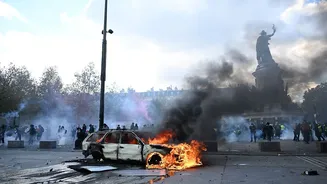
Thousands of demonstrators tried to reach Place de la République in central Paris. Police used tear gas against groups dressed in black and wearing masks, who burned cars and threw rocks at officers.A rapid-response riot unit, CRS 8, was sent to the Les Halles area, the Paris police prefecture confirmed. The prefecture said it chose an agile approach because the marches were expected to move fast, with units stepping in systematically to restore calm. CRS 8 is trained to deal with urban violence.
A BBC reporter on the ground said the mood had turned “a lot more heated and hostile” in the last few hours. Another BBC correspondent described a clear contrast between the official march and small groups bent on causing trouble. Sirens rang constantly, tear gas hung in the air, and the reporter saw smashed buildings, looting and glass bottles being thrown. Some protesters, who the BBC said had come from the suburbs looking for a fight, even turned on each other. The reporter stated that it was not safe to be on the streets.
Attacks on public buildings across the country
France saw about 140 demonstrations on Saturday afternoon, including in Bordeaux, Toulouse and Nantes. According to the Financial Times, the government had expected more than 100,000 people to turn out. Later in the day, Interior Minister Laurent Nuñez gave a much higher figure of 550,000.Nuñez said the authorized marches went ahead as planned. But he said groups from the “hard left and extreme left” pushed the situation into disorder at the edges of the protests, and that there was a clear aim to hit public buildings in many cities. The interior ministry also reported attacks on police officers and looting.
The ministry listed the damage:
- Marseille: Intruders got into city hall, and businesses were vandalized. Protesters also surrounded a police station and threw rocks at it. According to the mayor and TV images, another group stormed the entrance of city hall, sprayed graffiti on the walls and knocked over a bust of Marianne, the symbol of the French republic.
- Lyon: The tourist office was set on fire and shops were damaged.
- Avignon: People entered the courtyard of the Vaucluse prefecture.
- Grenoble: City hall was damaged.
- Pau, Montpellier, Toulouse and Valence: Businesses were vandalized.
- Lille: Police used tear gas as they clashed with protesters. Photos appeared to show a group trying to force its way into the town hall, with a damaged door inside the building. AFP and local media reported that some people got in before running off.
The loss of Lyon’s tourist office
Lyon Mayor Grégory Doucet called the fire “a tragedy” for his city. Pictures showed masked protesters smashing the windows before flames started inside. Local police said “hostile individuals” stopped firefighters from putting out the blaze.Doucet told BFMTV the loss was heartbreaking because the building is a well-known, historic landmark. He said he had spoken to the prefect and told local police to concentrate on protecting public buildings, and that those open to the public had been evacuated hours earlier.
What officials and politicians said
The interior ministry accused far-left groups of carrying out “targeted, violent operations” and warned that more incidents were likely during the day. It said “black bloc” groups had formed inside the marches, with far-left elements at their center. In Paris, it said several unsanctioned groups were trying to reach seats of power, and police were stepping in to block them.Prime Minister Sébastien Lecornu said France would not be “intimidated.” People have a right to protest peacefully, he said, but there is no room for arson, looting or attacks. He singled out anyone treating the violence as a “warm-up” for the presidential election and warned that no one will push a political agenda through force. He also praised police for facing “extreme violence” and said they deserve public support.
President Emmanuel Macron posted on X that there is no place for violence in the Republic. He promised that people who attacked prefectures and businesses, or looted town halls, will be prosecuted and punished. He expressed the nation’s support for police, whom he called guardians of the right to demonstrate, and said the country must stand united against “sowers of chaos” who want to bring down institutions and stop peaceful protesters from being heard.
Opposition figures disagreed on the day’s meaning. Marine Le Pen, the National Rally candidate, said “rioters” were “poisoning” the protests, that the far left had hijacked the protesters’ demands, and that groups excusing violence want to throw the country into chaos. Jean-Luc Mélenchon of La France Insoumise said “everything is unfolding in calm” and argued that the media were fixated on the violence.
Police tactics
At least 400 people had been arrested by mid-afternoon, the interior ministry said. The government has also allowed stun grenades to be used in some cases, even though it had limited their use during other recent protests.Why people are protesting
The Financial Times reported that the day followed several weeks of protests by high school students who say the education system is failing them. Their revolts have shut down lycées (suburbs) and led to thousands of arrests, and teachers, students and hundreds of police officers have been hurt in clashes. The students want better conditions and more money for classrooms.Others are on the streets because of rising living costs, including higher fuel prices, and a welfare system they say is not working for them. The BBC noted that yellow vests were also calling for action on the cost of living.
A tense political backdrop
The unrest comes while France faces a fiscal reckoning, with bond markets uneasy about its worsening public finances and its ability to bring down a large deficit. The presidential election to choose Macron’s successor is due in April, about six months away, and Le Pen is the frontrunner.The protests also recall the Gilets Jaunes, or yellow vests, whose angry demonstrations in 2018 and 2019 included occupying roundabouts and blocking roads. They caused a crisis during Macron’s first term.