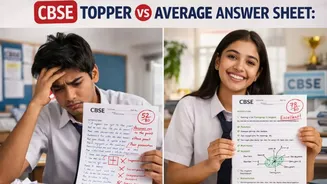

Have you ever pondered what the difference is between an answer script written by an average student and that of a top rank holder? What is it that sets
them apart from a student scoring just passing marks? Sometimes, students spend hours studying for their boards, join a coaching institute, and even become front benchers just to comprehend the topics a little better than the rest; however, the outcome remains the same. Why? What is it that they're doing wrong that's costing them crucial marks in the CBSE board examinations 2026? If you're someone who's finding answers to these queries, you have come to the right place. Today, we will enlighten you on the mistakes you have been making, along with ways to rectify them.
Clarity of Concepts
You can cram as hard as you can for days, but the results wouldn't be in your favour. Why? Because fundamental understanding of a concept is everything. You don't need to write definitions 'as it is'; rather, you must comprehend the concept and convey it in your own words. If it's related to Mathematics, Economics, or Physics, make sure to use correct formulas and laws to avoid deduction of marks. Most importantly, avoid vague lines such as 'it is something related to...'.
Presentation
Believe it or not, the presentation of your responses means a lot. Do not stuff or club words in a hassle; rather, leave enough margins and spacing for the examiner's convenience. Underlining the keywords or sentences with a pencil or pen is something you should inculcate in your habit, as it highlights the crucial part. Also, ensure your handwriting is tidy and consistent throughout the sheet. Although using fancy fonts isn't possible given the time limit, writing neatly is what you should do at the least since an examiner cannot award marks for something he/she cannot read.
Structured Answers
Writing an introduction and shortly jumping to the conclusion is something you should avoid. Always begin with a 1–2 line introduction, then proceed to the body part explaining the concept, putting forth arguments and substantiating them before arriving at a conclusion. Writing main points in 'bullet' form or short paragraphs helps an examiner understand the topic easily; therefore, adhere to this format.
Diagrams & Flowcharts
The biggest mistake an average student makes is avoiding diagrams and flowcharts wherever necessary. If you're coming across a question that requires it, ensure that you draw it. Skipping diagrams and charts can be detrimental to your answer sheet. Moreover, make good use of arrows and boxes for processes while maintaining relevancy without overdoing it.
Answer Relevance
This is perhaps one of the most common errors that students make, with haste in reading the question paper being its major cause. Always take your time to read the question paper meticulously, without rushing to write. When you hurry in filling the sheet, you end up answering what has not been asked. Ensure your focus is on responding to what's being questioned; if the question is asking for 'causes', do not write 'effects'.
Also, storytelling does not fetch numbers in today's era. Stick to necessary explanations and mark-wise length.
These are the most common discrepancies that a topper stays away from and you cling to. It also substantiates the popular saying, "Toppers don't do different things, they do things differently." Therefore, avoid these in the future to increase your chances of becoming a top ranker.
Recommended | CBSE Results 2026: The 33% Rule, Grace Marks & Hidden Pass Chances Explained