






The oil is on the boil. In nine days, the Houthis, an Iran-aligned armed group that controls much of northern Yemen, have moved from an inland siege line
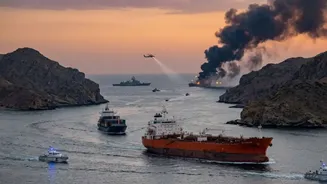
to physical control of the Bab el-Mandeb Strait, a waterway that carries close to 12% of global trade. Brent crude has closed above $100 a barrel for three straight sessions, its first sustained run past that mark since July. This is not a coincidence, and the market has stopped pretending it is. The question driving that market is narrow and answerable: how close is this armed group to Saudi Arabia's big oil? The honest answer is that its biggest hubs — Ras Tanura, the world's largest crude export terminal, and Abqaiq, its largest processing complex — remain roughly 1,650 kilometres away, out of ground range. The distance hasn't changed. What changed is everything around it. Here is how, in nine days. Nine days, kilometre by kilometre September 3 — The offensive opens The group launches its largest coordinated ground assault since the 2022 UN truce, driving through western Taiz and southern Hodeidah toward the Red Sea. The front is still about 90 km inland. Yemen's internationally recognised government mobilises; neither Riyadh nor Washington issues a statement. September 4 — Government reinforces, loses ground anyway Government forces rush reinforcements into Taiz and Hodeidah and recapture a single position. A strike on Jabal Habashi district displaces thousands. On balance, the militia gains territory. September 5 — The deadliest day At least 60 fighters are killed in 24 hours — 26 government troops and 31 from the attacking side, by rival counts. Separate missile strikes on a civilian bus and a crowded road near Taiz kill 10 civilians. Reinforcements arrive from Aden. Saudi Arabia and the United States remain non-participants on the ground. September 6 — Tactical gains, no strategic shift The government reports retaking ground in Hodeidah and advancing in western Taiz. The International Crisis Group and other analysts assess the gains as tactical, aimed at recovery rather than a reversal of the advance. The trajectory toward the coast is unchanged. September 7 — The front reaches the coast Displaced families arrive in Mokha itself, a measure of how close the fighting has come to the Red Sea. There is still no direct Saudi or US military intervention. September 8 — Saudi oil facilities hit A drone-and-missile barrage strikes four Saudi border cities — Abha, Jazan, Najran and Khamis Mushait — wounding more than 70 people and igniting fires at oil and utility sites. These provinces have been within the group's missile range for years; this is not new ground, but it is a direct hit on Saudi infrastructure. The Saudi-led coalition intercepts some projectiles and strikes back. The barrage continues. September 9 — The market re-prices No major territory changes hands, but Brent crude closes back above $100 for the first time since late July. It is the clearest signal yet that traders have re-rated the advance from a distant risk to a live one. September 10 — Mokha falls The group captures the port city of Mokha — its biggest territorial gain in years — forcing government and allied forces to retreat about 46 km south to Dhubab, just short of the strait. Saudi warplanes strike Mokha's airport. According to multiple reports, Saudi Crown Prince Mohammed bin Salman personally asks President Donald Trump for direct US military action against the group. As of the latest reporting, that request is unanswered; Washington says only that it remains "in continuous dialogue" with Riyadh. September 11 — Both banks of the strait Fighters cross by boat and seize Mayyun (Perim) Island in the middle of the 28-km-wide Bab el-Mandeb Strait. The group now overlooks both shores of one of the world's busiest shipping lanes. Hours later, Saudi Arabia shuts its East-West pipeline — its Red Sea bypass around the Strait of Hormuz — as a precaution after further drone strikes. No US forces deploy. A Gulf Cooperation Council-Iran meeting is instead scheduled in Oman to address the other blocked chokepoint, Hormuz.
Why the distance matters less than it looks
Two chokepoints, squeezed at once. The Red Sea advance is unfolding while a separate US-Iran war keeps the Strait of Hormuz, which once moved roughly a fifth of the world's oil, largely shut. The world's two primary oil arteries are constrained simultaneously.
The big hubs are far, but their bypass is gone. Ras Tanura and Abqaiq sit on the opposite Gulf coast, about 1,650 km from Mokha and 1,715 km from Mayyun, beyond ground reach. Saudi Arabia's answer to a blocked Hormuz was to route crude west by pipeline to the Red Sea. That pipeline is now switched off.
The response has been diplomacy and airstrikes, not intervention. Saudi Arabia has hit captured positions from the air; the US has not committed forces despite a direct request. For now, the advancing side has faced no decisive external check.
None of this is settled. The advance of the Houthis continues, the government's counter-gains are tactical, the US-Iran escalation has no ceasefire in sight, and Hormuz remains unresolved. Brent has risen faster this past week than in months, and forecasters who earlier treated $120 as a worst case are no longer dismissing it.
The market's question is no longer whether oil holds above $100. It is whether both of the world's great chokepoints being pressured at the same time pushes crude toward the level nobody wants to name: will this be the run that takes oil to $150 a barrel?