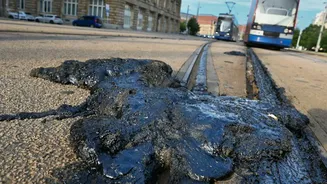










Europe's relentless heatwave is no longer just a weather story. It is becoming an infrastructure crisis. As temperatures climbed beyond 40 degrees Celsius
across large parts of the continent, roads began to soften, tram tracks warped under the heat, railway services were disrupted and hospitals struggled to cope with a surge in heat-related emergencies. From France and Germany to Italy, Switzerland, Denmark, the Czech Republic and the United Kingdom, authorities were left battling the effects of one of the most intense early-summer heatwaves in recent memory. Videos circulating on social media captured roads visibly deforming under the scorching sun, while transport operators warned passengers to expect significant disruption as vital infrastructure came under mounting pressure.
In France, the asphalt is melting in the heat. A “heat dome” has been hanging over Europe for a week, and forecasters say temperatures will exceed 40°C in the shade in the coming days. pic.twitter.com/LMhZKbBjUY
— распад и неуважение (@VictorKvert2008) June 24, 2026
Record-Breaking Temperatures Leave Transport Networks Under Strain
The heatwave, which first scorched western Europe before moving eastward, shattered temperature records across multiple countries within days. Denmark registered its hottest day since weather observations began in 1874, with temperatures reaching 37°C in Ødum. Switzerland recorded 38.8°C in Basel, while the Czech Republic touched a record 40.8°C in Doksany.
Britain also rewrote its weather history after recording 37.3°C, making it the hottest June day ever measured in the UK. Germany experienced some of the most dramatic infrastructure failures.
📌 It’s so hot in Germany the Autobahn literally burst open at the seams
— Context 360 (@NewsContext360) June 28, 2026
Temperatures have reached a record 42°C, causing tram tracks to buckle and forcing a complete suspension of tram services in Leipzig. Parts of the city's bus network have also been affected by the intense… pic.twitter.com/dgGfe4CzuP
On the A2 Autobahn outside Berlin, concrete slabs expanded and burst under the extreme heat, forcing emergency closures. Other sections of the motorway network also suffered heat-related damage as prolonged exposure caused road surfaces to deteriorate.
Rail travel faced similar challenges. Germany's national rail operator, Deutsche Bahn, advised passengers to avoid non-essential journeys over the weekend, warning that exceptionally high temperatures were affecting tracks, signalling systems and overall network reliability.
France also witnessed mounting disruption. Reports described roads softening under sustained heat, while transport services experienced delays as temperatures pushed infrastructure beyond normal operating limits.
Hospitals, Power Grids And Public Services Feel The Pressure
The impact of the Europe heatwave has extended far beyond transport. In Dormagen, Germany, authorities evacuated dozens of residents from a nursing home after indoor temperatures climbed to 35°C, creating dangerous conditions for elderly occupants. One resident died overnight, although officials said it remains unclear whether the death was directly linked to the extreme heat.
France's healthcare system also came under severe pressure. Public hospitals in Paris reported nearly 3,000 emergency admissions for a second consecutive day—roughly one-third higher than normal—as heat-related illnesses surged. Emergency plans were activated across all 38 public hospitals in the capital after medical dispatch centres experienced an almost 80 per cent increase in emergency calls compared with the same period last year.
The extreme temperatures also affected electricity generation. State-owned energy company EDF said it had reduced output at several nuclear power stations because warmer river water limited cooling operations, although officials stressed electricity supplies remained secure. Authorities were also forced to postpone the Paris Pride march and cancel a major three-day music festival over concerns about public safety and emergency service capacity.
Italy And UK Continue To Monitor Dangerous Conditions
Italy maintained red heat alerts across 18 cities, including Rome, Milan, Florence, Venice and Bologna, with residents and tourists seeking refuge in shaded public spaces as temperatures remained exceptionally high. In Britain, amber heat warnings stayed in force despite forecasts suggesting slightly cooler conditions.
Police recovered the bodies of a 22-year-old man and a 15-year-old boy from separate bodies of water, bringing the week's reported heat-related deaths to four. Authorities again urged the public to avoid swimming in unsupervised lakes and rivers during the hot spell.
Meteorologists say while temperatures may ease in some western regions over the coming days, much of central and eastern Europe is expected to remain under intense heat, prolonging pressure on transport networks, healthcare systems and critical infrastructure.