





What is the story about?
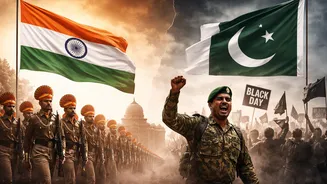
Every year on 26 January, India marks Republic Day. And every year, Pakistan responds with a predictable ritual of denunciation—branding it a “Black Day”,
invoking Kashmir, and attempting to strip legitimacy from India’s constitutional order. This response is not incidental. It is symptomatic of a deeper discomfort with what Republic Day actually represents. Republic Day is not a parade. It is not optics. It is a reminder of where authority resides in the Indian state—and why that authority has endured while Pakistan’s has repeatedly fractured.
Republic Day: The Moment Power Was Bound by Law
India did not become a republic automatically on independence. Between 1947 and 1950, the country deliberately chose to subordinate power to a written Constitution. On 26 January 1950, sovereignty formally shifted from colonial structures to a legal framework rooted in popular consent, fundamental rights, and institutional accountability.
That decision matters because it set the terms of Indian statehood. Authority would not flow from the military, the mob, or momentary political mobilisation. It would flow from the law.
Republic Day commemorates that restraint.
Why Pakistan’s “Black Day” Narrative Falls Apart
Pakistan’s annual attempt to frame India’s Republic Day as illegitimate—especially in relation to Jammu and Kashmir—rings hollow when examined against its own constitutional record. Pakistan has repeatedly seen its constitution abrogated or suspended. Civilian governments have been overthrown. Unelected power centres have overridden parliamentary authority.
This is not polemic; it is history.
A state that has struggled to preserve constitutional continuity is poorly positioned to lecture another that has maintained it for over seven decades. Pakistan’s “Black Day” rhetoric is less a moral critique and more an expression of institutional insecurity.
Kashmir and the Question of Legitimacy
The Kashmir issue is often used to challenge India’s republican credentials. But India’s claim over Jammu and Kashmir has always rested on constitutional processes—accession, representation, judicial oversight, and the extension of rights—not on a perpetual emergency or military fiat.
This does not mean the region has been free of conflict or contestation. It means that India has consistently framed the dispute within a constitutional framework rather than reducing it to grievance politics or external mobilisation.
Pakistan, by contrast, has relied on internationalisation, proxy violence, and rhetorical escalation—tools that bypass constitutional stewardship rather than reinforce it.
Authority Versus Grievance
Republic Day draws a line between two models of statehood in South Asia.
One model grounds authority in institutions, procedures, and law—even when inconvenient. The other substitutes grievance for governance and mobilisation for legitimacy.
India’s republic has endured precisely because it chose the former. Pakistan’s discomfort with Republic Day stems from the fact that it exposes this contrast every year.
The Strategic Value of Constitutional Continuity
In national security terms, constitutional continuity is not an abstract virtue. States that maintain institutional legitimacy are better able to manage dissent, absorb shocks, and project stability. Those that do not are forced to rely on coercion, narrative control, or external scapegoats.
India’s Republic Day is therefore not inward-looking. It signals to the region that India’s authority is procedural, not personal—and that disputes will be handled through institutions, not perpetual mobilisation.
That signal is what unsettles its critics.
Beyond the Parade
The military parade will continue to attract cameras. But the real message of 26 January lies elsewhere. It lies in the fact that India’s most powerful day is not about seizing power, but about limiting it.
In a region where constitutions have often been treated as disposable, India’s Republic Day asserts something more enduring: power survives longest when it is restrained by law. That is why Republic Day matters, and that is why Pakistan cannot ignore it.