







What is the story about?
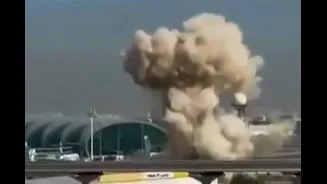
DUBAI, United Arab Emirates (AP) — Iran launched attacks on the world’s busiest international airport and targeted commercial vessels on Wednesday, coinciding
with ongoing U.S. and Israeli military actions in Tehran. The United Nations Security Council has demanded an end to Iran's aggressive actions against its Gulf neighbors, which pose risks to global oil supplies. The recent assaults signify a heightened phase in Iran's strategy to inflict economic damage globally, pressuring the United States and Israel to cease hostilities that have persisted for 12 days. Despite these developments, the conflict shows no signs of de-escalation.
Impact on Bahrain and Iraq
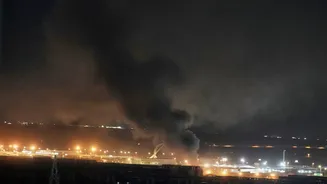
On Thursday, an Iranian strike ignited a significant fire on Bahrain’s Muharraq Island, which hosts the kingdom's international airport. Authorities advised residents to remain indoors and close windows to mitigate exposure to smoke. The airport's vicinity includes jet fuel tanks critical for the region's oil industry.Additionally, an attack on Iraq’s Basra port resulted in at least one fatality and disrupted operations at the country's oil terminals. Farhan al-Fartousi, the director-general of Iraq's General Company for Ports, confirmed that a vessel in a ship-to-ship transfer area was targeted. While Iraq's commercial ports remain operational, oil terminal activities have been suspended, according to a report from the state-run Iraqi News Agency.
Financial Toll of the Conflict
The Pentagon estimated that the first week of the conflict with Iran incurred costs of $11.3 billion, a figure shared with Congress during a recent briefing. Notably, $5 billion of this expenditure was attributed to munitions used in the initial weekend of hostilities.Both the U.S. and Iran have fortified their positions, aiming to outlast one another as the conflict disrupts trade routes, constricts fuel and fertilizer supplies from the Gulf, and jeopardizes air traffic in a heavily trafficked region.
International Response to Iran's Actions
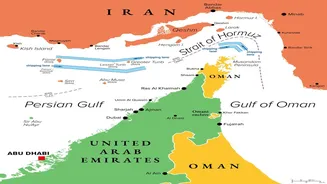
Iran has targeted oil facilities and refineries in Gulf Arab nations, effectively halting cargo movement through the strategic Strait of Hormuz, a vital passage for one-fifth of the world’s traded oil.In reaction to these developments, the International Energy Agency has agreed to release 400 million barrels of oil, marking the largest emergency oil reserve release in its history. The U.S. plans to contribute an additional 172 million barrels from its Strategic Petroleum Reserve in response to escalating prices.
UN Condemnation of Iranian Attacks
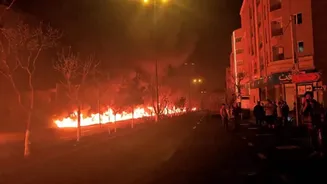
The U.N. Security Council passed a resolution on Wednesday, calling for an immediate cessation of Iran's 'egregious attacks' on Gulf nations. This resolution reflects the international community's increasing concern over Iran's military aggression.Recent incidents include two Iranian drones striking near Dubai International Airport, resulting in four injuries, although flights continued as scheduled. Firefighters also responded to a blaze at a luxury apartment tower in Dubai Creek Harbor following an Iranian drone strike.
Ongoing Military Engagements
In Oman, crews worked to extinguish a fire at fuel storage tanks at Port of Salalah, as reported by the Oman News Agency. Bahrain’s U.N. ambassador, Jamal Alrowaiei, remarked, 'The international community is resolute in rejecting these Iranian attacks against sovereign countries, threatening the stability of a region crucial to global energy and trade.'The U.N. resolution passed with a 13-0 vote, underscoring Iran's isolation amid its aggressive military responses. Notably, China and Russia abstained from the vote, criticizing the resolution for failing to address the strikes against Tehran that initiated the conflict.
Escalating Violence in Israel and Lebanon
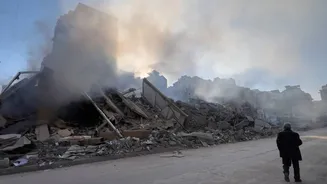
On Thursday, explosions rocked Jerusalem and other parts of Israel as the Israeli military conducted extensive strikes in Tehran. Concurrently, Israel targeted locations in Lebanon associated with Iran-backed Hezbollah militants.One strike in Beirut's Ramlet al-Bayda area killed seven individuals and injured 21, according to the Lebanese Health Ministry. The Israeli military reported being unaware of the strike's occurrence in that area.
In a notable escalation, blasts in Beirut's southern suburbs resulted in significant damage, as Israel's military retaliated against Hezbollah's barrage of rockets into northern Israel, marking one of the most intense exchanges since the conflict began.