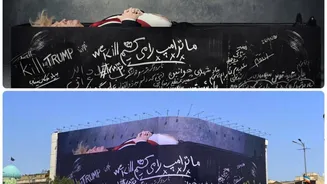


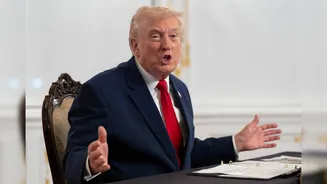



A giant billboard depicting US President Donald Trump inside an open black coffin has appeared in Tehran's Enghelab Square, marking one of the most provocative
public displays since the latest phase of the Iran War began. The installation surfaced as the United States expanded its military campaign against Iran with fresh strikes targeting military infrastructure linked to operations around the Strait of Hormuz. The billboard portrays Trump lying motionless inside a black coffin with his eyes closed, hands folded across a red tie and his feet pointing upwards. White graffiti painted across the coffin reads "We Will Kill Trump" in both Persian and English, while another message says "In memory of Minab's children," referring to the southern Iranian city where an elementary school was struck during military operations on February 28.
🇮🇷🇺🇸 Iran is really poking the bear now...
A new billboard in Tehran's Revolution Square shows Trump in a coffin, alongside the words:
"We will kill Trump."
Hardliners have been calling for revenge in the days since Khamenei's funeral, and the U.S.-Iran situation has only… pic.twitter.com/ea4H5CNMm2— Mario Nawfal (@MarioNawfal) July 15, 2026
The imagery appears to form part of Iran's broader psychological messaging campaign following the death of former Supreme Leader Ayatollah Ali Khamenei and the continuing military confrontation with Washington. The billboard was erected in one of Tehran's busiest public squares, ensuring maximum domestic and international visibility.
CENTCOM Expands Air Campaign Against Iran
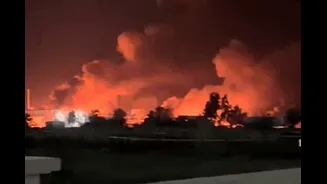
The appearance of the billboard coincided with another major offensive by US Central Command (CENTCOM). In a statement, CENTCOM said American forces concluded a fresh wave of strikes at 9 p.m. ET on July 15, targeting Iranian command centres, air defence systems, missile and drone capabilities, and coastal surveillance facilities.
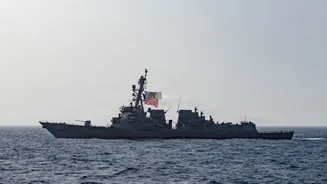
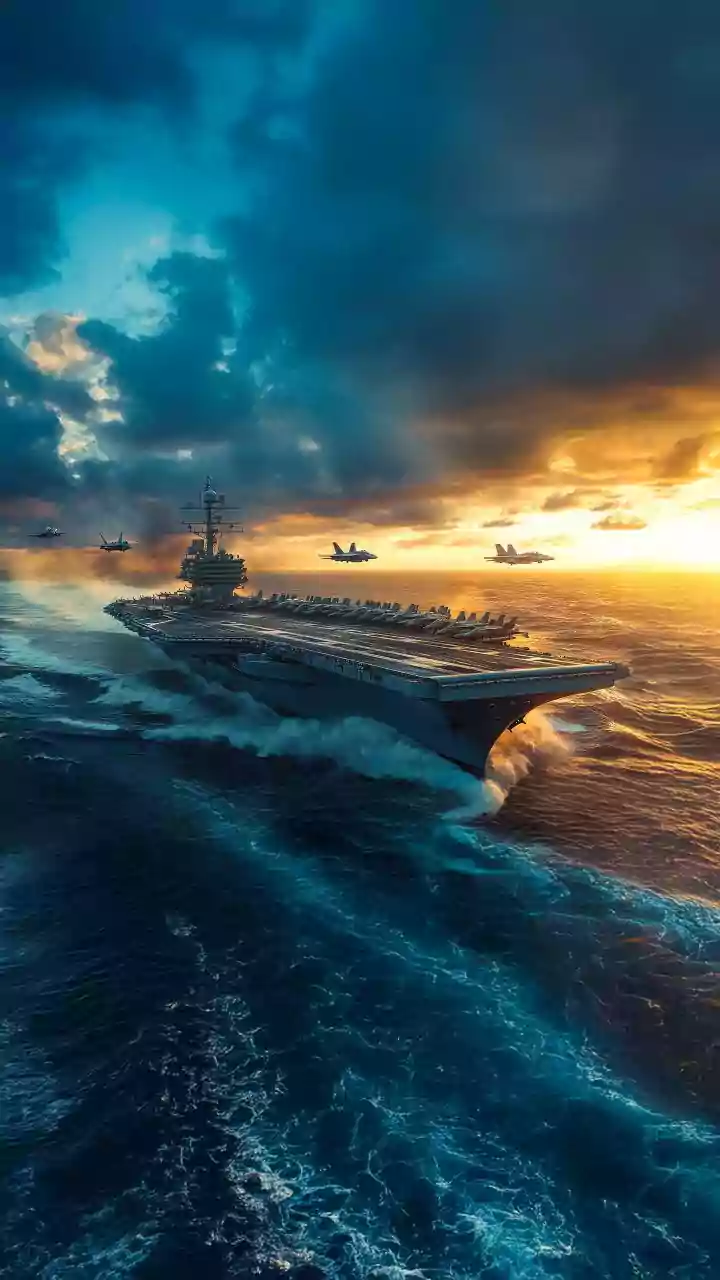
U.S. sailors conduct nighttime flight operations aboard USS George H.W. Bush (CVN 77) while transiting the Arabian Sea. pic.twitter.com/uzJcrfGFXO
— U.S. Central Command (@CENTCOM) July 15, 2026
According to the US military, precision-guided munitions were employed against multiple targets, including Bandar Abbas, with the objective of degrading Iran's ability to threaten commercial shipping passing through the Strait of Hormuz. CENTCOM also confirmed a separate 90-minute operation earlier in the day against Iranian coastal defence and cruise missile positions on Greater Tunb Island, a strategically significant island overlooking one of the world's busiest maritime chokepoints.
The strikes form part of Washington's broader campaign aimed at protecting commercial shipping following repeated attacks on vessels transiting the Gulf and enforcing the renewed US naval blockade targeting Iranian ports.
Iran Reports Strike Near Cancer Hospital
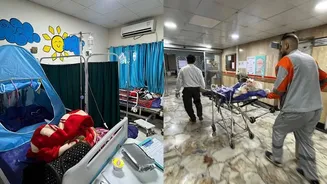
While the United States described the operation as focused on military targets, Iranian authorities reported that missile strikes also landed near civilian infrastructure. Hossein Kermanpour, head of the Public Relations and Information Centre at Iran's Ministry of Health, said areas surrounding Boghayi Hospital 2 in Ahvaz, which specialises in treating cancer patients, were struck.
In a statement posted on X, Kermanpour said frightened patients and their relatives fled the hospital after powerful explosions shook the surrounding area, leaving only the most critically ill patients inside the facility. Iranian officials did not immediately provide details regarding casualties or the precise target of the strike.
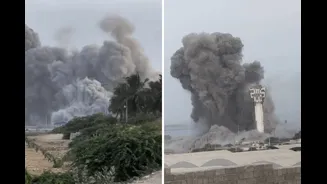
Separately, Iran's state broadcaster IRIB reported limited damage to the Souza fish powder factory on Qeshm Island in Hormozgan Province following what authorities described as an enemy attack. Officials said the facility was largely empty at the time and no injuries had been reported.
The appearance of the anti-Trump billboard alongside continuing military exchanges underscores the increasingly psychological dimension of the conflict, with both sides intensifying military operations while simultaneously seeking to shape public perception through highly symbolic messaging.