







A significant build-up of United States military assets in the Middle East is fuelling indications that Washington may be preparing for a high-risk, time-sensitive
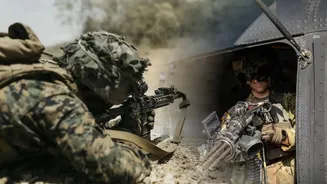
operation deep inside Iranian territory. Over the past several days, multiple elite formations — including elements of the United States Navy SEALs, Delta Force, Army Rangers, and DEVGRU — have reportedly been deployed alongside conventional forces. These movements coincide with the arrival of roughly 2,500 Marines and nearly 2,000 paratroopers from the 82nd Airborne Division. The scale is notable. Estimates suggest that more than 50,000 US troops are now positioned across the broader theatre, reflecting a transition from limited strikes to a posture capable of supporting complex ground operations.
High-Risk Objective Under Consideration
At the centre of emerging discussions is a potential mission involving the recovery of highly enriched uranium from damaged Iranian nuclear facilities. Captain SB Tyagi (Retd) notes that such an operation would require inserting special forces into hostile territory, securing a perimeter under fire, and locating sensitive nuclear material believed to be stored in multiple containment units. Notably, Indian Army's Cold Start Doctrine is based on similar principles.
The operational complexity is extreme. Open Source Intelligence suggest that teams would need to conduct rapid excavation in contested conditions, identify radioactive material, and extract it safely — all while under threat from Iranian forces and proxy elements. Time is a critical factor. A mission of this nature could take several days to execute, requiring sustained air cover, intelligence coordination, and rapid extraction capabilities.
Strategic Calculus: Strike Or Negotiate
The reported military option comes alongside a parallel diplomatic track.
Officials have indicated that the preferred outcome would be for Iran to hand over such material through negotiations. However, Tehran has so far resisted direct engagement with Washington, keeping military contingencies in focus.
This creates a narrow decision window. While a full-scale occupation of Iranian territory remains unlikely — given the size and complexity of the country — limited, high-impact operations are seen as more feasible within current US strategy.
As one analyst noted, such missions are not about holding ground.
They are about precision, speed, and extraction.
Operation Epic Fury Context
The developments unfold under the broader framework of what has been described as Operation Epic Fury. Recent updates from US Central Command indicate that more than two-thirds of Iran’s missile, drone, and naval production infrastructure has been degraded, alongside significant damage to its naval fleet.
This degradation shapes the battlefield. Reduced Iranian capacity to project force may create operational windows for specialised missions — though risks remain high, particularly in contested coastal and inland zones.
Global Signals Of War Economy Posture
Beyond the battlefield, the wider geopolitical environment is shifting. Several countries across the Middle East and beyond have taken economic measures typically associated with wartime conditions — including currency interventions, fiscal tightening, and restrictions on financial flows.
While not all measures are directly linked to the Iran conflict, the timing suggests a broader anticipation of prolonged instability. The ripple effects are already visible. Energy markets remain volatile, regional economies are under strain, and global supply chains are adjusting to sustained disruption in critical corridors.
High Stakes, Limited Margin For Error
For Washington, the calculus is stark. A successful operation could neutralise a key strategic concern — preventing sensitive nuclear material from being weaponised or dispersed. Failure, however, would carry significant consequences.
Loss of elite personnel, escalation with Iran, and potential regional spillover remain real risks. At this stage, no official confirmation has been issued regarding the execution of such a mission. But the pieces, as military observers note, appear to be moving into place.