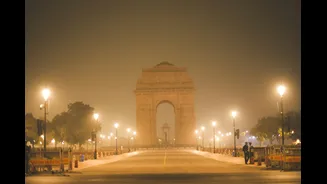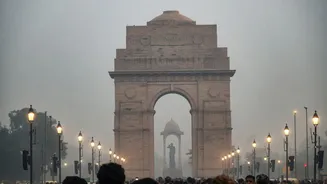







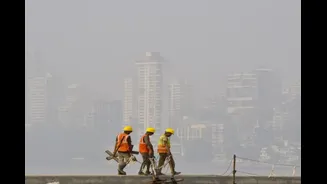
Delhi's air quality remained in the 'moderate' category on Sunday after overnight rains in the national capital region. The Air Quality Index (AQI) in Delhi was
recorded at 175 between 7 and 8 AM and a forecast that it may reach up to 317, which would mean that it may once again end up in a very poor category. Under Central Pollution Control Board (CPCB) guidelines, an AQI between 0 and 50 is categorised as 'good', 51 to 100 as 'satisfactory', 101 to 200 as 'moderate', 201 to 300 as 'poor', 301 to 400 as 'very poor', and 401 to 500 as 'severe'. On Friday, Delhi recorded an AQI of 223 at 8 a.m., placing the national capital in the 'poor' category, according to the Central Pollution Control Board (CPCB). Earlier on Saturday, Delhi recorded an AQI of 191, the lowest for October 24 in a decade, excluding the Covid period, the Delhi government said, attributing the improvement to sustained pollution control measures. According to a statement issued by the Environment Department, the AQI stood at 306 on October 24 in 2024 and 275 on the corresponding date in 2025, before declining to 191 this year. Environment Minister Manjinder Singh Sirsa said the improvement reflected the government's efforts to tackle pollution through enforcement, monitoring and public participation. An AQI of 191 falls in the 'moderate' category. The government said nearly 9,883 vehicle challans were issued in the last 24 hours as part of its anti-pollution drive. During the same period, 2,810 km of roads were mechanically swept and 1,075 km covered through water sprinkling to control dust. Authorities also removed 12,702 metric tonnes of waste, lifted 2,223 metric tonnes of construction and demolition waste, inspected 160 construction and demolition sites or plots, and collected 168 metric tonnes of road dust, the statement said. Sirsa said the government would continue its anti-pollution campaign in "war mode", with strict enforcement, continuous monitoring and public participation. The government said it would continue field inspections, technology-based monitoring and enforcement to address pollution sources and further improve air quality in the national capital. With inputs from PTI