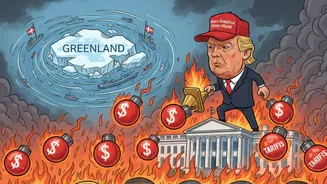

US President Donald Trump has sharply escalated tensions with Europe by announcing new tariffs on imports from eight NATO allies after they rallied behind
Denmark in the growing standoff over Greenland. The move marks one of the most serious ruptures in transatlantic relations in years, bringing trade coercion directly into the NATO alliance. In a social media post, Trump said the United States will impose a 10% tariff from February 1, rising to 25% by June, unless “a Deal is reached for the Complete and Total purchase of Greenland.” He argued that US ownership of Greenland is essential for national security and to prevent Russia or China from expanding their influence in the Arctic. Countries hit by the proposed US tariffs The tariffs would apply to the following eight NATO members and close US partners:
- Denmark
- Norway
- Sweden
- France
- Germany
- United Kingdom
- Netherlands
- Finland
Several of these countries are among America’s largest trading partners and form the core of Europe’s political, economic and military relationship with Washington.
Strong backlash from Europe
European leaders responded with unusually blunt criticism. The European Union declared its full support for Denmark and Greenland, warning that tariffs against allies risk triggering a dangerous downward spiral in transatlantic relations.
EU leaders Ursula von der Leyen and Antonio Costa said Europe would remain “united, coordinated and committed to upholding its sovereignty.” EU ambassadors are expected to meet to discuss countermeasures, including the possibility of freezing or scrapping the US-EU trade truce agreed last year.
National leaders echoed the warning:
- France’s Emmanuel Macron called the threats “unacceptable.”
- Sweden’s Ulf Kristersson said his country would not be “blackmailed.”
- UK Prime Minister Keir Starmer described the use of tariffs against NATO allies as “completely wrong” and said he would raise the issue directly with Washington.
Trade deal at risk
Trump’s move also puts existing trade agreements in jeopardy. Under a July deal, the US imposed 15% tariffs on most EU exports and 50% tariffs on steel and aluminium, but the European Parliament has not yet ratified the agreement. Senior EU lawmakers have now signaled that the deal may be suspended or blocked entirely in response to the Greenland-related tariff threat.
Analysts warn this could reopen a full-scale US–EU trade conflict at a time of global economic uncertainty.
Legal uncertainty in the US
It remains unclear how Trump would legally implement the tariffs. Previous tariff threats relied on emergency economic powers that are now under scrutiny by the US Supreme Court, with a ruling expected soon. Another possible legal route would cap tariffs at 15% and limit their duration, raising doubts over how long the measures could stay in force.
Greenland, NATO and the Arctic
The dispute intensified after Denmark invited NATO allies to participate in training and security activities in Greenland. Several European countries have since deployed small military contingents, framing the move as a response to rising Arctic security risks, particularly from Russia.
Trump has portrayed these deployments as provocative, warning that countries supporting Denmark are “playing a very dangerous game.” He has repeatedly argued that the US must own Greenland outright, not lease it, to secure strategic dominance in the Arctic and support future missile defense projects such as his proposed “Golden Dome” system.
European officials insist that Greenland’s status cannot be changed through economic pressure and that international law cannot be rewritten with tariffs. As the standoff grows, the episode is increasingly seen as a major stress test for NATO unity, US-EU trade relations, and the future balance of power in the Arctic.