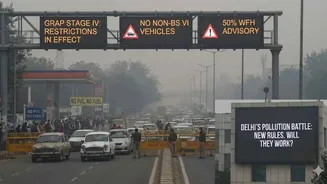

The Delhi government on Wednesday unveiled its toughest measures yet to rein in the capital's soaring AQI. As part of the Stage IV of the Graded Response
Action Plan (GRAP), the Rekha Gupta government announced a ban on non-BS VI vehicles registered outside the city, denial of fuel to vehicles without valid Pollution Under Control (PUC) certificates, and a mandatory work-from-home (WFH) policy for 50% of employees in government and private offices. Construction and demolition activities have also been suspended, and trucks carrying construction material have been barred from entering the city. The government announced Rs 10,000 compensation to ease the burden on registered and verified construction workers affected by the halt in work. These measures, effective immediately, aim to curb the rising pollution levels and bring some relief to the capital's residents.
Delhi Govt Enforces Pollution Norms
The government clarified that the restriction on non-BS VI vehicles will remain in force only as long as GRAP-IV is active. "If enforced beyond Stage IV, it would have led to massive disruption," a government official said.
Vehicles without a valid PUC will not be allowed to refuel at petrol pumps. To ensure compliance, a policeman and a transport department official will be stationed at each fuel station. Delhi Traffic Police have intensified enforcement at city borders and major arterial roads, deploying over 500 personnel, 37 Prakhar vans, and 126 checkpoints, including RFID-enabled entry points, to prevent non-compliant vehicles from entering the city.
Officers noted that e-challan systems will be used to instantly verify a vehicle's emission norms and registration details.
The 50% WFH mandate extends to all government and private offices in the NCT, with exemptions for essential services including hospitals, utilities, transport, enforcement, and disaster response.
Environment Minister Manjinder Singh Sirsa said these measures target four major sources of pollution - vehicles, industries, dust, and solid waste.
He also announced plans for a Delhi-specific carpooling app, the use of Google Maps data to identify congestion hotspots, and an integrated traffic management system to reduce idling and improve signal coordination.
Addressing the public and fuel station operators, Sirsa said, "This campaign is not to cause inconvenience but to make Delhi's air breathable again. Every Delhiite must ensure their vehicle's PUC is up to date - it's a collective responsibility."
Delhi Smog: Will Curbs Really Work?
While these may be Delhi's strictest anti-pollution drives in recent years, experts warn that temporary restrictions may not deliver long-term impact.
"All the steps suggested for vehicular pollution were tried in India, but they didn't work only because there wasn't a political will," Sunil Dahiya, Founder and Lead Analyst at EnviroCatalyst, said.
Even with these curbs, the city may continue to face severe AQI episodes if these actions remain sporadic rather than sustained.
How China Dealt With Its Smog Crisis
Lessons from Beijing, which was once the "smog capital of the world", highlight the importance of large-scale, sustained interventions.
Chinese authorities combined strict vehicle emission norms, phase-out of old vehicles, expansion of public transport, and industrial relocation across the Beijing-Tianjin-Hebei region to achieve a drastic drop in PM2.5 levels over a decade.
Beijing's annual PM2.5 average fell from 101.7 µg/m³ in 2013 to 30.9 µg/m³ in 2024. Experts point out that the scale, stringency, and continuity of action in Beijing were crucial to its success.
Anumita Roy Chaudhuri, Executive Director at the Centre for Science and Environment, notes a key gap in Delhi's approach: "We will find similarities in our plans for Delhi-NCR but the scale is missing. In China, action was not taken just in Beijing but in 26 cities and towns to tackle the problem, which is regional. The first lesson is that the actions they took were urgent, stringent, and at a large scale."
In Delhi, measures are largely reactive, implemented only during severe pollution episodes, and without comprehensive regional coordination.
In the end, while GRAP-IV and the new restrictions may temporarily reduce vehicular emissions and ease smog levels in the short term, its lasting impact will depend on sustained enforcement and public adherence to pollution norms. Without this, Delhi may continue to face annual smog crises, no matter how tough the measures appear on paper.