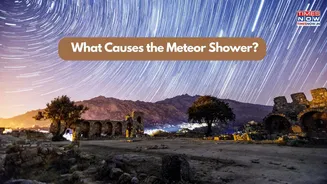






Are you ready for one of the best skywatching opportunities of the year? The Geminid meteor shower will be visible across the world tonight, especially
in the Northern Hemisphere. And guess what the best part is? No special equipment is needed to watch it. Did you know the Geminids can produce several bright meteors per minute under clear, dark skies? Take this quiz to check your knowledge of the Geminid meteor shower. 1. What annual celestial event is discussed in the passage? A. Perseid meteor shower B. Leonid meteor shower C. Geminid meteor shower D. Orionid meteor shower Correct answer: C 2. When are the Geminids expected to peak? A. At the start of winter B. During the daytime C. Tonight D. At the end of the year Correct answer: C 3. Which hemisphere is likely to see more Geminid activity? A. Southern Hemisphere B. Northern Hemisphere C. Eastern Hemisphere D. Western Hemisphere Correct answer: B 4. What equipment is required to watch the Geminids? A. Telescope B. Binoculars C. Camera D. No special equipment Correct answer: D 5. Meteor showers occur when Earth passes through trails left by what objects? A. Planets B. Stars C. Objects moving through space D. Satellites Correct answer: C 6. Most meteor showers originate from which type of celestial body? A. Asteroids B. Planets C. Comets D. Moons Correct answer: C 7. According to NASA, comets are often described as what? A. Rocky fragments B. Cosmic snowballs C. Burning rocks D. Solar debris Correct answer: B 8. What makes the Geminids different from most meteor showers? A. They occur during summer B. They come from a planet C. They originate from an asteroid D. They are visible only in India Correct answer: C 9. What is the name of the asteroid linked to the Geminids? A. Halley B. Bennu C. Apophis D. 3200 Phaethon Correct answer: D 10. What happens when particles from Phaethon enter Earth’s atmosphere? A. They freeze B. They slow down C. They heat up and burn D. They reflect sunlight Correct answer: C 11. What are meteors commonly called when they appear as bright streaks? A. Falling stars B. Shooting stars C. Solar flares D. Space dust Correct answer: B 12. What causes the different colours seen in meteors? A. Speed of the meteor B. Size of the asteroid C. Elements present in the meteor D. Cloud cover Correct answer: C 13. Which element can produce meteor colours similar to fireworks? A. Oxygen B. Hydrogen C. Sodium D. Helium Correct answer: C 14. What recent discovery about Phaethon has raised new scientific questions? A. It has ice B. It has rings C. It has a sodium gas tail D. It has moons Correct answer: C 15. Why are the Geminids scientifically interesting? A. They are predictable B. Their origin is fully understood C. Researchers are still studying how they formed D. They are the fastest meteors Correct answer: C 16. Why are the Geminids ideal for students to observe? A. They require advanced equipment B. They last for many hours C. They are reliable and frequent D. They occur every month Correct answer: C 17. From which constellation do the Geminids appear to radiate? A. Orion B. Taurus C. Gemini D. Leo Correct answer: C 18. Why is it better to look slightly away from the radiant point? A. To avoid eye strain B. To see longer meteor streaks C. To spot constellations D. To reduce light pollution Correct answer: B 19. Which locations in India are suggested for clearer views? A. Coastal cities B. Crowded urban areas C. Higher elevations and rural areas D. Industrial zones Correct answer: C 20. What message does the passage convey to students? A. Learning happens only in classrooms B. Meteor showers are rare events C. Science can be experienced directly in nature D. Technology is essential for observation Correct answer: C Keep visiting this page for more such interesting quizzes.