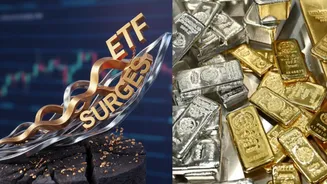

As we enter the third week of January 2026, gold and silver exchange-traded funds (ETFs) are firmly in the spotlight. Both metals have been on a strong
run since late 2025, with gold futures hovering near record highs of $4,500–$4,600 per ounce, while silver has pushed past $80–$96 per ounce in volatile trading sessions. In India, domestic gold prices briefly crossed Rs 1.5 lakh per 10 grams, while silver neared Rs 3 lakh per kg. These levels have triggered intense activity in gold and silver ETFs—both domestic and global—marked by heavy volumes, sharp price swings, and heightened investor interest. From Tata Silver ETF and Groww Gold ETF in India to global heavyweights such as SPDR Gold Shares (GLD) and iShares Silver Trust (SLV), these instruments have witnessed record inflows, dramatic single-day rebounds of 17–30%, and occasional panic sell-offs of 15–24%. The key question now: what’s driving this momentum, and can it last? 1. Record-Breaking 2025 Performance Set the Stage The rally in early 2026 is an extension of an extraordinary 2025 for precious metals:
- Gold surged around 64–66%, marking its second-best annual performance since 1979.
- Silver exploded 140–148%, its strongest yearly gain in more than four decades.
- Global gold ETFs saw record inflows of roughly $89 billion, according to the World Gold Council, with total holdings rising to about 4,025 tonnes, the highest since the pandemic era.
- Silver ETFs, including SLV, posted even sharper gains, driven by both safe-haven demand and strong industrial consumption.
This momentum carried into January 2026, with gold up roughly 4–7% year-to-date, while silver surged 12–28% within just a few weeks, depending on market sessions.
2. Why Are Gold & Silver ETFs So Strong in Early 2026?
Several macroeconomic and market-specific factors are converging:
Geopolitical and Macro Uncertainty
Rising global risks—ranging from US tariff threats (including on precious metals) and tensions over Greenland, to instability in Venezuela, unrest in Iran, and concerns about Federal Reserve independence—have driven strong safe-haven flows into gold and silver.
Dollar Debasement and Currency Concerns
Fears of US dollar debasement, driven by rising debt levels, potential aggressive rate cuts in 2026, and speculation around a new Fed leadership, have made non-yielding assets like gold more attractive. Silver, often called the “poor man’s gold,” has amplified this move due to its smaller market size and higher volatility.
Central Bank and Institutional Buying
Central banks, particularly in China, India, and Turkey, continue to accumulate gold aggressively. JPMorgan forecasts ETF inflows of around 250 tonnes in 2026, with gold prices potentially reaching $5,000 per ounce by year-end.
Industrial Demand Boosting Silver
Silver’s dual role—as both a safe-haven and an industrial metal—adds to its appeal. Demand from solar panels, electronics, electric vehicles, and clean energy remains strong, while supply constraints persist.
Monetary Policy Expectations
Markets are pricing in a greater than 60% chance of US rate cuts by June 2026, which lowers real yields and supports precious metals. Lower borrowing costs also aid industrial demand, further benefiting silver.
ETF Inflows and Speculative Momentum
Heavy ETF inflows, especially from Asia, have reinforced the rally. In silver ETFs, speculative trading has led to extreme moves—such as Tata Silver ETF plunging 24% in one session and rebounding 17–30% the next—highlighting the momentum-driven nature of current flows.
3. Key ETF Performers in Early 2026
Global ETFs
- SPDR Gold Shares (GLD): Up about 7% YTD, with inflows exceeding $625 million.
- iShares Silver Trust (SLV): Up over 22% YTD, supported by massive inflows.
- Leveraged gold ETFs: Some posted outsized gains in 2025, showing amplified volatility.
Indian ETFs
- Tata Silver ETF: Extremely volatile, with sharp one-day falls followed by strong rebounds.
- Groww Gold ETF: Gained roughly 7–11% in recent sessions.
- Nippon India Silver ETF and others: Showing similar volatility, tracking MCX spot prices closely.
4. Risks and Outlook for 2026
Bullish forecasts dominate market commentary:
- JPMorgan: Gold could reach $5,000–$5,400 per ounce by Q4 2026.
- Sprott and others: Silver may extend its rally, with extreme scenarios pointing to $100–$200 per ounce.
- Bank of America: Gold mining stocks may outperform physical gold due to expanding margins.
However, key risks remain:
- Sharp corrections after parabolic moves, especially in silver.
- Any easing of supply constraints or slowdown in industrial demand.
- Profit-taking near record highs.
- Policy shifts, such as a stronger dollar or a prolonged Fed pause.
Should You Invest Now?
Gold and silver ETFs remain in strong uptrends in early 2026, supported by macro uncertainty, central bank buying, and safe-haven demand. They offer diversification, inflation protection, and in silver’s case, exposure to industrial growth.
However, after massive gains in 2025 and heightened volatility this year, timing matters:
- Long-term investors: Gradual allocation through dollar-cost averaging may make sense as a hedge.
- Short-term traders: Volatility offers opportunity but demands strict risk management.
- Caution: With prices near all-time highs, pullbacks are likely—avoid chasing euphoria.
As global uncertainty persists, precious metals and their ETFs continue to shine—but disciplined strategy is essential.
(Disclaimer: Prices and flows are live and subject to rapid change. Always conduct your own research or consult a financial advisor.)