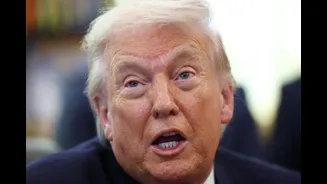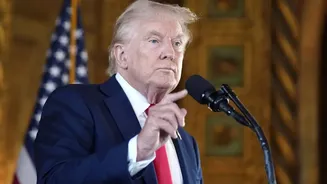

US President Donald Trump announced on Truth Social that he will not impose tariffs on Greenland and European nations, originally scheduled for February
1, following a “very productive meeting” with NATO Secretary General Mark Rutte. Trump described the new framework as a potential “great solution for the United States of America, and all NATO Nations.” He added that Vice President JD Vance, Secretary of State Marco Rubio, and Special Envoy Steve Witkoff would handle the ongoing negotiations, reporting directly to him. In his post, Trump wrote, “Based upon a very productive meeting that I have had with the Secretary General of NATO, Mark Rutte, we have formed the framework of a future deal with respect to Greenland and, in fact, the entire Arctic Region. This solution, if consummated, will be a great one for the United States of America, and all NATO Nations. Based upon this understanding, I will not be imposing the Tariffs that were scheduled to go into effect on February 1st.”
Trump also mentioned “additional discussions” regarding The Golden Dome in Greenland and said that more information will be shared as negotiations progress.
What US President Trump Said At Davos Forum
Earlier, at the World Economic Forum in Davos, Switzerland, Trump said he wants the United States to take control of Greenland, including its ownership, but claimed he would not use military force to do so.
Trump criticized European allies and said NATO should not block US plans to expand its influence. “What I’m asking for is a piece of ice, cold and poorly located,” Trump said.
He added that compared to what the US has done for NATO over many years, his request was small. “It’s a very small ask compared to what we have given them for many, many decades,” he said.
READ ALSO | Trump's Off-script Greenland Moment At Davos WEF: 'Say Yes, We'll Be Appreciative, Say No And We'll Remember'
Trump urged NATO members to allow the US to take Greenland from Denmark and issued a warning to allies who oppose the move. “They can say yes, and we’ll be very appreciative,” Trump said. “Or you can say, ‘No,’ and we will remember," he added.
Trump also claimed Greenland already belongs to the US based on geography.
During his speech, Trump said the US economy is strong, but claimed Europe is struggling. Trump added that the United States wants strong allies, not weak ones. “We want strong allies, not seriously weakened ones,” he said.
The suspension of tariffs affects multiple European countries including Denmark, France, Germany, the United Kingdom, the Netherlands, Sweden, Norway, and Finland, which were threatened with levies tied to the Greenland issue.
Prior to the suspension, Trump had threatened 10% tariffs starting February 1 and up to 25% by June 1 unless a deal was reached.
Trump said that his negotiators will continue talks on the framework deal with NATO and Arctic partners. He added that more information will be shared as discussions progress.
Why Did Trump Earlier Threaten Tariffs On European Allies?
President Donald Trump earlier threatened to impose steep tariffs on several European countries as they opposed his push to gain control over Greenland, a semi-autonomous territory of Denmark.
Trump said that if European allies did not agree to negotiate over Greenland, the United States would start charging import taxes of 10% beginning February 1, rising to 25% by June on goods from countries such as Denmark, France, Germany, the United Kingdom, the Netherlands, Sweden, Norway, and Finland.
READ ALSO | 'All I'm Asking Is A Piece Of Ice': At Davos, Trump Threatens Greenland, Slams NATO - Top Quotes
Trump linked the tariff threat to his claim that Greenland is important for US national security. He said other countries were not doing enough to protect the Arctic region.
Trump used the tariff threat as pressure on US allies to support America’s goals in Greenland and the Arctic.
European leaders had said tariffs against longtime allies would harm transatlantic relations and could disrupt trade and cooperation. Some European officials called Trump’s tariff threat a mistake and warned it harmed trust and existing trade deals.