






As the Iran-Israel conflict widens beyond direct missile exchanges and threatens to reshape regional alliances, attention is increasingly turning northward
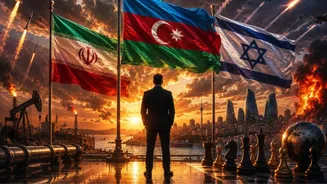
to Azerbaijan, a country that has long tried to balance relations with competing powers but now finds itself at the center of a rapidly evolving geopolitical contest. Bordering Iran, maintaining deep strategic ties with Israel, and serving as a crucial energy supplier to Europe, Azerbaijan is emerging as one of the most consequential states watching the conflict unfold from the front row. Azerbaijan occupies a unique geopolitical position. The South Caucasus nation shares a 700-kilometre border with Iran while maintaining a deep strategic partnership with Israel. The relationship spans energy, trade, defence cooperation and diplomatic engagement. For years, Baku has supplied significant volumes of oil to Israel through the Baku-Tbilisi-Ceyhan (BTC) pipeline network, making energy cooperation a cornerstone of bilateral ties. Reports over the past year have indicated that Azerbaijani crude continues to reach Israel despite changes in official customs reporting. That relationship has often generated unease in Tehran, which views Israel's growing footprint in the region as a direct security concern.
Iran's Northern Frontier Under the Spotlight
Iran's concerns about Azerbaijan are not solely about energy. The two countries are separated by more than geography. They represent competing regional visions and increasingly divergent strategic alignments.
While Iran remains deeply suspicious of Israeli influence near its borders, Azerbaijan has steadily expanded its ties with Israel over the last two decades, particularly in defence and technology sectors.
The result is a relationship marked by periodic diplomatic tensions, military rhetoric and competing regional interests.
The Azeri Factor Inside Iran
Adding another layer of complexity is demography. Ethnic Azerbaijanis constitute Iran's largest non-Persian ethnic community. Estimates vary, but most studies place the population in the tens of millions, concentrated largely in northwestern Iran. Most Iranian Azerbaijanis are deeply integrated into Iranian political, economic and social life. However, their presence remains a sensitive issue in regional politics because cultural and linguistic links connect communities on both sides of the border.
As tensions between Tehran and Baku periodically rise, the issue often re-enters geopolitical discussions across the region.
Europe's Energy Security Also Runs Through Azerbaijan
The significance of Azerbaijan extends far beyond the Middle East. Since Europe began reducing dependence on Russian energy supplies, Azerbaijan has become an increasingly important alternative source of natural gas through the Southern Gas Corridor. European officials continue to describe Azerbaijani energy supplies as a key component of the continent's energy security strategy.
That means any instability involving Azerbaijan could have consequences extending well beyond the South Caucasus, potentially affecting energy markets, transit routes and European supply chains.
Despite its close relationship with Israel, Azerbaijan has consistently sought to avoid becoming a direct participant in wider Middle Eastern conflicts. Baku's foreign policy has traditionally focused on balancing relations among regional powers including Turkey, Iran, Russia, Israel and Western partners.
However, as the Iran-Israel confrontation intensifies, maintaining that equilibrium may become increasingly difficult.
Azerbaijan's strategic geography, energy resources and regional partnerships mean it can no longer be viewed as merely a neighbour of the conflict. It is increasingly becoming a stakeholder in its outcome.
The Iran-Israel confrontation is no longer confined to traditional Middle Eastern flashpoints. From the Gulf to the South Caucasus, regional actors are being forced to navigate new strategic realities. For Azerbaijan, the challenge is especially acute: preserve vital partnerships, avoid direct confrontation and maintain stability along one of the most sensitive borders in Eurasia.