






What is the story about?
Russian Hybrid Attacks against Europe and France have intensified in recent weeks, French President Emmanuel Macron has warned, as European governments
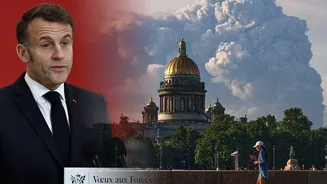
remain concerned about the security risks linked to the ongoing Russia-Ukraine War. Speaking at a news conference at the Elysee Palace, Macron said he had ordered a plan to protect critical infrastructure and sensitive defence industry sites against the growing threat. Macron said France itself had been targeted by Russian hybrid attacks in recent weeks and warned that they would not be left “without a response”. He said the objective was to intimidate European countries and weaken their determination to support Ukraine, but argued that the pressure would have the opposite effect.
Macron Orders Protection Of Critical French Sites
The French President said the government had been tasked with strengthening protection for critical infrastructure as well as the country's most sensitive defence and technology facilities. The measures are intended to address threats including drone and cyberattacks, which form part of what European governments broadly describe as hybrid activity.
Macron's warning came after he met French party leaders to discuss the security consequences of the wars in the Middle East and Ukraine. During the briefing, he pointed to recent developments in Germany and Poland as part of a wider pattern of concern over potential Russian activity against European states.
Macron specifically referred to last month's drone attack on Leipzig airport in Germany, which Germany has blamed on Russia. He also cited comments by Polish Prime Minister Donald Tusk, who has warned that Russia could be preparing drone and missile strikes against Poland and other countries on NATO's eastern flank.
“In recent weeks, the Russian hybrid threat against Europeans and against France has intensified,” Macron said. He added that the purpose was to intimidate European countries and undermine their efforts to support Ukraine, arguing that France was not prepared to be deterred by such pressure.
The comments come as European governments increasingly discuss the possibility of hostile activity below the threshold of conventional warfare. Hybrid warfare is a broad term covering methods such as cyberattacks, sabotage and disinformation, which can be used to exert political or economic pressure without a conventional military attack.
Poland Warns Of Possible Russian Strikes
Tusk told Polish MPs on Thursday that Russian plans could include drone and missile strikes against countries supporting Ukraine. The Polish Prime Minister said there was a “real risk” of such attacks reaching NATO territory and warned that Moscow could subsequently describe them as accidental in an attempt to create divisions within the alliance.
Another incident cited in the wider European security debate occurred last Sunday, when a Russian drone hit a passenger train near the Ukraine-Poland border. The incident took place shortly after former UK Prime Minister Boris Johnson and senior European security officials had travelled along the same railway line.
Ukraine said passengers had been evacuated only minutes before the strike at Yahodyn, which hit the train's engine. The incident has added to concerns in the region over the possibility of drones crossing or operating close to European borders as the war in Ukraine continues.
Moscow has repeatedly denied that it intends to attack Europe. Russian Foreign Minister Sergey Lavrov, however, has warned European countries against deploying troops to Ukraine, saying Russia would regard such a move as a declaration of war.
“If Europe attacks Russia, it will be a completely different war, and it will be very short,” Lavrov said. Macron's latest warning therefore comes amid a widening European debate over how to respond to threats that fall short of an acknowledged conventional attack. France is now preparing additional measures to protect sensitive infrastructure and defence-related sites, while other European governments continue to assess the risks posed by drones, cyber operations and other forms of hostile activity.
Macron also announced a separate effort on energy security, saying France would call a meeting of the G7 to discuss energy supplies and raise the issue of gas stocks with the European Commission. He said the meeting would examine ways to strengthen cooperation and consider whether strategic reserves could be released if required.
“In the coming weeks, we will have a G7 meeting devoted to these energy issues, both to strengthen cooperation and to avoid unnecessary tensions between the G7 countries and our main partners,” Macron said.
He added that the meeting would also provide an opportunity to consider options for a possible release or “unlocking” of strategic reserves.