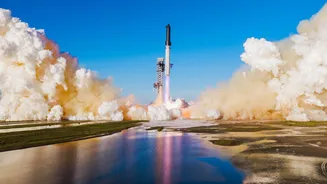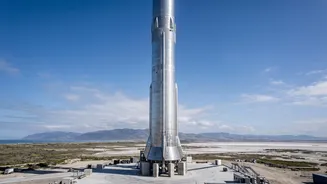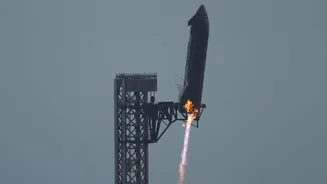




SpaceX's giant Starship spacecraft has successfully returned from orbit and been caught by mechanical arms at its launch site in South Texas, marking a major
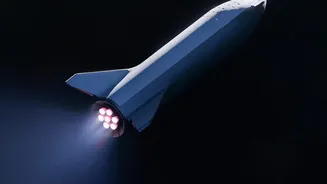
milestone in the company's efforts to develop a fully reusable rocket system. The spacecraft was caught between two mechanical arms, nicknamed "chopsticks", on the launch tower on Saturday afternoon. The feat was achieved during Starship's 15th test flight, which began on Friday afternoon. It was the first time SpaceX had successfully brought the spacecraft's upper stage back from orbit and caught it at the launch site. Starship, which is about 170ft long, was travelling at more than 17,000mph at an altitude of around 170 miles when one of its engines fired briefly, pushing it out of orbit and beginning its descent towards Earth. As it entered the atmosphere, air pressure heated the spacecraft's underside and slowed it down. Flaps at the front and rear then helped steer it through the denser atmosphere.
Amazing. Congratulations Elon Musk and SpaceX. What a sight. 🇺🇸🇺🇸 https://t.co/G6CGx6lSDA
— Brendan Carr (@BrendanCarrFCC) November 14, 2026
The spacecraft passed over Mexico before emerging from the clouds above Starbase, SpaceX's launch facility at the southern tip of Texas.
During its final descent, Starship fired its engines and turned into a vertical position. It hovered briefly before moving between the mechanical arms, which closed around it and held it in place.
SpaceX has spent the past decade developing technology to recover and reuse the boosters of its smaller Falcon 9 rockets. Those boosters have been successfully landed and reused on subsequent launches.
However, the upper stages of Falcon 9 rockets are still discarded after each flight. Starship is considerably larger than Falcon 9 and was designed to be fully reusable from the outset. Recovering its upper stage after it has travelled into orbit represents a significant technical challenge.
SpaceX managed to achieve that feat on its first attempt.
Congratulations to an incredible team at SpaceX!!! https://t.co/phiZ0amQyp
— Elon Musk (@elonmusk) November 14, 2026
During the latest test flight, the spacecraft also deployed 26 of the company's next-generation Starlink satellites after reaching orbit.
The company had hoped to achieve an even more ambitious result by catching both sections of the rocket. The lower section, known as Super Heavy, is the giant booster that propels Starship into space.
SpaceX has already caught the booster during three previous test flights. A successful recovery of both the booster and spacecraft would have marked the company's first "double-catch" manoeuvre.
However, after completing its part of the mission, the booster detected a problem with its guidance and navigation control system. It therefore carried out a simulated landing over the Gulf of Mexico instead of returning to the launch tower.
Despite Saturday's success, experts say SpaceX still has significant work to do before it can demonstrate that Starship's heat shield and engines can be prepared for another launch quickly after enduring the stresses of atmospheric re-entry.
The spacecraft must be able to withstand the intense heat and pressure of its return journey before it can be reliably reused.
Nevertheless, successfully recovering the upper stage from orbit marks an important advance in SpaceX's effort to develop rockets that can be launched, recovered and flown again. The achievement brings the company closer to its goal of making spaceflight more reusable.