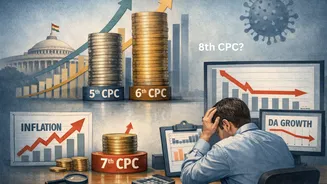

8th Pay Commission News: The pace of Dearness Allowance (DA) increases under the 7th Central Pay Commission (CPC) has been noticeably slower compared to
earlier pay panels. DA, which compensates employees for inflation, is an essential part of government salaries, but its growth under the 7th CPC has lagged behind both the 5th and 6th CPC. This trend could influence overall wage gains when the 8th Pay Commission recommendations are implemented. During the 6th CPC, which ran from 2006 to 2016, DA surged to 125 per cent of the basic salary, a sharp rise compared to the 74 per cent increase recorded under the 5th CPC between 1996 and 2006. Under the 7th CPC, DA currently stands at 58 per cent of basic pay. With the next revision scheduled for March, it is expected to inch up to around 60 per cent. Biannual Revisions And The Pandemic Pause DA and Dearness Relief (DR) for pensioners are updated twice a year, in March and October, with retrospective effect from January and July. However, the growth rate of DA under the 7th CPC was impacted significantly by an 18-month freeze during the COVID-19 pandemic. The government paused revisions to DA and DR to manage the financial strain on the exchequer amid the health crisis. The 8th Pay Commission, established in November 2025, is not expected to table its report before mid-2027. Until then, DA will likely be revised at least three more times, reaching an estimated cumulative 70 per cent before the rollout of the new commission, suggest the reports. Lower DA Could Mean Higher Effective Wage Hike A key factor in calculating real salary increases is that DA resets to zero whenever a new pay panel is implemented. Even a moderate fitment factor under the 8th Pay Commission could lead to substantial wage gains if DA remains relatively low. For context, when the 7th Pay Commission was rolled out in 2016, it recommended a fitment factor of 2.57, raising the basic minimum salary from Rs 7,000 to Rs 18,000. However, with the resetting of DA, the effective salary increase was tempered. At the end of the 6th CPC, minimum pay stood at Rs 19,200, including basic pay, DA, HRA, and TA. Under the 7th CPC, the minimum wage rose to Rs 23,670. This reflected an effective growth of 14.3 per cent, less than what the basic fitment factor alone would suggest. With DA now at less than half its previous proportion, central government employees may see a more pronounced wage boost when the 8th CPC comes into effect.