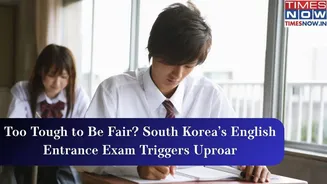








South Korea's top authority entrusted with the task of holding the country's critical university entrance test has stepped down from his position after
receiving severe backlash due to the difficulty level of the English section this year. Oh Seung-geol, head of the Korea Institute for Curriculum and Evaluation, has resigned from his post, acknowledging that the test could not meet the standards of its absolute-grading system instituted in 2018. Reports suggest that only 3.11 per cent of candidates earned the top grade, which is the lowest since the system was set up. Speaking on the issue, Oh Seung-geol said that some questions had been revised due to similarities found with private mock tests later. “In so doing, we were not able to properly assess the difficulty level of some questions,” he added. Of 12 chiefs who called it quits because of test-setting errors, Oh Seung-geol's resignation was atypical. Office Hours Delayed, Flights Grounded: A Nation on Hold for Suneung Suneung is one of the most challenging entrance exams in the world, deciding students' university and career prospects. In order to clear it, students spend years in preparation. While some crack it in one go, others give attempt after attempt in the hope of improving their scores or securing admissions to reputable institutes. Not just preparation, even appearing for the exam is considered mentally and physically exhausting, as it takes almost eight hours to complete, with parents and teachers waiting outside the centres, praying for the best. To ensure the smooth conduct of the exam, office hours are delayed to allow students to reach centres on time, aeroplanes are rerouted or grounded to avoid noise during the listening test, and police help late students reach test centres on motorcycles and even patrol cars. Extra efforts are taken for the smooth conduct of Suneung, as it often impacts an individual's social image, job opportunities, and even wedding prospects in society. What Went Wrong? Though the English section had always been considered challenging, this year's question paper, carrying Immanuel Kant's philosophy of law and another involving gaming jargon, sparked outrage among the people, as per BBC reports. One question instructed students to decide on the correct placement of a sentence related to avatars and virtual perception, a task many labelled as unnecessarily twisted. Can You Solve This? A video game has its own model of reality, internal to itself and separate from the player's external reality, the player's bodily space and the avatar's bodily space. (1) The avatar's bodily space, the potential actions of the avatar in the game world, is the only way in which the reality of the external reality of the game world can be perceived. (2) As in the real world, perception requires action. (3) Players extend their perceptual field into the game, encompassing the available actions of the avatar. (4) The feedback loop of perception and action that enables you to navigate the world around you is now one step removed: instead of perceiving primarily through interaction of your own body with the external world, you're perceiving the game world through interaction of the avatar. (5) The entire perceptual system has been extended into the game world.
- Correct answer: 3
Many condemned the phrasing of the question, calling it “fancy smart talking” and “awful writing,” failing to convey the idea.
With students awarded 70 minutes to attempt 45 questions, only 3 per cent of this year's examinees bagged the top grade for English, a drastic fall from 6 per cent last year.
While defending the complexity, Kim Soo-yeon, an English literature professor at Hankuk University of Foreign Studies in Seoul, said that it measures students' reading comprehension and assesses if they can handle university-level reading.
Recommended | Explained | Japan or China: Best Country to Study Design in 2026