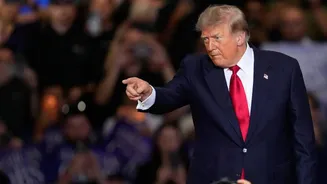






US President Donald Trump on Monday said he paused military strikes against Iran to give diplomacy another opportunity, but warned that the United States
could resume military action if negotiations fail. Speaking to Axios, Trump said talks were under way on a possible agreement that could reopen the Strait of Hormuz and revive negotiations over Iran's nuclear programme. The discussions are being conducted primarily between Iran and Oman, with Qatar, Pakistan, Egypt and US envoys Steve Witkoff and Jared Kushner also involved. "We are in very deep talks with Iran. If they don't work out, we will go back to very strong military action," Trump told Axios. Asked how long he was prepared to give diplomacy, he replied: "Not much time. Either it goes fast or not at all." Trump said he decided to halt strikes on Friday after mediating countries and regional partners urged him to give negotiations another chance. "All of the people that deal with Iran asked me: 'Don't fire,'" he said, adding that he believed Tehran wanted to reach an agreement.
🇺🇸 Trump says US is in “very deep talks” with Iran, warns military action could resume soon if diplomacy fails
🔹 Speaking to reporters aboard Air Force One, President Donald Trump said there was a “good chance” of reaching an agreement with Iran but warned that “if it doesn’t,… https://t.co/QfF66SlAZW pic.twitter.com/6bpSCzPsaA— Drop Site (@DropSiteNews) July 27, 2026
Explaining his decision, Trump said: "Nothing gained, nothing lost." He also noted that oil prices had fallen and stock markets had risen after the military pause.
According to an Axios report, Trump ordered US forces on Friday to suspend planned strikes on Iranian targets along the country's southern coast and in the Strait of Hormuz after meeting senior military commanders and advisers.
The report said he had been leaning towards resuming major military operations in the days before the meeting, but changed course on Thursday evening before finalising the decision on Friday.
Regional sources told Axios that negotiations between Oman and Iran had made progress, although no agreement had yet been reached.
Omani Foreign Minister Badr al-Busaidi said he had spoken by telephone on Monday with counterparts in Iran, Qatar, Saudi Arabia, Kuwait and Egypt.
In a statement, he said the discussions "focused on ways to enhance the prospects for reaching practical, fair and sustainable arrangements for maritime navigation ... through the Strait of Hormuz."
One proposal under discussion would allow Iran, Oman and other regional countries to collect "reasonable service fees" for maritime security, environmental protection and related services, according to a regional source cited by Axios.
The source said the Strait of Malacca, where Malaysia, Indonesia and Singapore charge vessels for certain services, could provide a model. Another proposal would place the fees into a joint fund administered with the involvement of the International Maritime Organization.
Trump is due to meet Israeli Prime Minister Benjamin Netanyahu at the White House on Tuesday. "I am going to talk to Bibi about the fact that if I weren't president, Iran would have had nuclear weapons by now and Israel would have been destroyed," Trump said.
Meanwhile, Iran's Deputy Foreign Minister for Legal and International Affairs, Kazem Gharibabadi, said Tehran had rejected a US proposal during recent negotiations in Islamabad, describing it as containing "extreme demands".
"The US side presented a proposal that reflected extreme demands. The Iranian delegation explicitly rejected this proposal," he said at a conference for legal professionals.
According to Gharibabadi, US negotiators warned that rejecting the proposal would end the talks. "The US side stated that if this proposal were rejected, the negotiations would be considered a failure and they would leave," he said, adding that the American delegation subsequently ended the negotiations.
He said Iran had made no attempt to persuade the United States to continue the talks. "There was absolutely no insistence or pleading from the Iranian delegation to continue the negotiations, and this approach was an example of the Islamic Republic of Iran's 'dignified diplomacy,'" he said.
Gharibabadi also referred to discussions over the Strait of Hormuz, saying Iran had rejected a proposal to keep a southern shipping route open while negotiations continued.
"The other side insisted that the southern route, which had been opened for ship traffic, remain open until the Iran-Oman negotiations reached a conclusion and only then be closed, but the Iranian delegation did not accept this proposal," he said. "We explicitly declared that whatever the outcome of the negotiations, the principled policy of the Islamic Republic of Iran had been clear since the beginning of the war, and such proposals would not be accepted."
Later on Monday, Trump again expressed confidence that diplomacy could succeed.
"I have a lot of patience," he told reporters when asked how long he was willing to wait for an agreement. "I have plenty of time. Plenty of time."
He said discussions with Iran were progressing. "We're having good talks," Trump said. "I think there's a good chance that something could happen. And if it does, good, if it doesn't, we go back to doing what we were doing two days ago."
Trump also said the Strait of Hormuz was in "very good shape", despite Iran's recent efforts to interfere with shipping through the strategic waterway, and added that Iran had requested meetings with the United States both directly and through intermediaries.