





What is the story about?
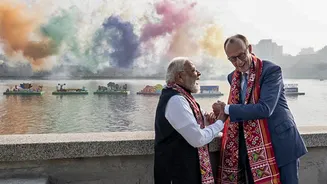
India and Germany on Monday unveiled measures to boost cooperation in areas of defence, trade, critical minerals and semiconductors, with Prime Minister
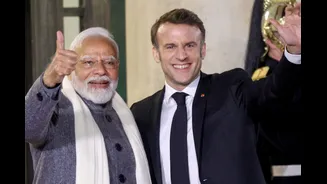
Narendra Modi and ChancellorFriedrich Merz vowing to bolster overall bilateral ties to jointly navigate challenges arising out of geopolitical upheaval. The leaders announced a visa-free transit for Indian passport holders for transiting through Germany. German Chancellor Merz announced visa-free transit for Indian citizens, saying that it would further strengthen people-to-people ties between the two nations. Prime Minister Modi thanked Chancellor Merz for the same. "I express my gratitude to Chancellor Merz for announcing visa-free transit for Indian citizens," PM Modi said.
On people-to-people ties between India and Germany, PM Modi recalled the historical connections between the two countries, citing Rabindranath Tagore, Swami Vivekananda and Madam Bhikaji Cama as symbols of long-standing cultural and intellectual exchanges. "Today, we are transforming this historical connection into a modern partnership," he said.
Visa-Free Transit for Indians - What Changes?
Earlier, any Indian national transitioning via Germany was required to have a Schengen transit visa, also known as a category A visa. Even if Indian nationals stayed within the international transit area at airports such as Frankfurt, Munich, or Berlin, they were required to have a Schengen transit visa. This mandate applied despite passengers not entering Germany or the wider Schengen area.
Also Read -Australia Tightens Student Visa Checks: India Moved To Highest Risk Category — What It Means For Applicants
Now, under the new arrangement, it will become easier for Indian passport holders, and they would be able to pass through German airports for onward international connecting flights.
Modi-Merz Meet in Ahmedabad
India and Germany inked 19 pacts during a meeting between Prime Minister Narendra Modi and Chancellor Friedrich Merz in Ahmedabad on Monday. The pacts include defence industrial collaboration, cooperation in the higher education sector, and engagement in the telecommunications sector, among others.
Modi and Merz also reaffirmed their strong support for the India-Middle East-Europe Economic Corridor (IMEC), emphasising its transformational potential in reshaping and promoting global commerce, connectivity and prosperity.
In the talks, Modi and Merz reaffirmed their commitment to a free and open Indo-Pacific, respect for international law, including UNCLOS (UN Convention on the Law of the Sea), and announced a new bilateral Indo-Pacific consultation mechanism. The move comes amid China's increasing military muscle-flexing in the region.